
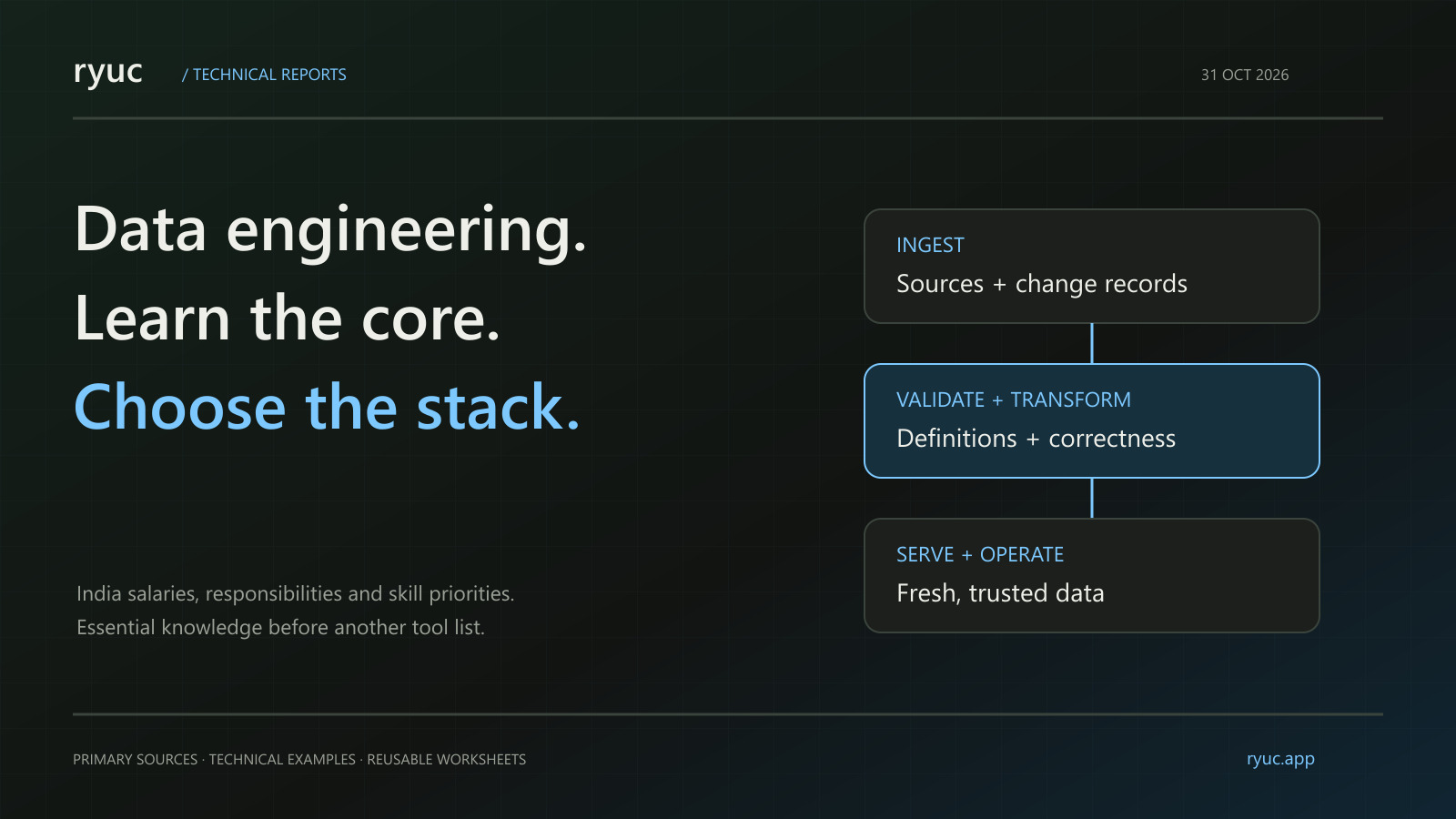
Data engineering job descriptions can read like a list of every data tool on the internet. That creates the wrong preparation strategy: learning a little Spark, Kafka, Airflow, Snowflake, dbt and three clouds without becoming reliable at any part of a real pipeline.
Short answer: a data engineer is accountable for making useful data available reliably, correctly and securely. In India, the most transferable preparation is strong SQL, production-oriented programming, data modeling, incremental processing, testing and operational ownership. Learn the tools required by the specific job family next. Streaming systems, lakehouse formats and AI data infrastructure can be valuable specializations, but they are not universal entry requirements.
Checked on 31 October 2026: this guide uses original employer advertisements, salary-platform disclosures and official technical documentation. Salary samples and advertised offers are kept separate. The skills priority system, project and learning plan are editorial recommendations, not a survey claiming that every Indian employer uses the same stack.
What does a data engineer actually own?
A data engineer builds and operates the paths between source systems and the datasets other people or applications consume. Consumers may include analysts, finance teams, product services, ML models or AI retrieval systems.
The job has six connected responsibilities.
Ingestion: collect data from databases, files, APIs or event streams. Handle pagination, rate limits, changing schemas, credentials and missing records. Decide how to capture updates and deletions, not just new rows.
Transformation and modeling: turn raw records into meaningful entities and facts. Define the grain of a table, business keys, joins, units and historical behavior. A table that loads successfully but double-counts revenue is a failed data product.
Reliable operation: schedule dependencies, handle retries, perform backfills and recover from partial failure. A pipeline should have a known answer to “What happens if this task runs twice?”
Quality and observability: detect freshness problems, duplicates, invalid values and changes in distributions. Establish who receives an alert and what they can do about it. A dashboard full of green job statuses does not prove the business data is correct.
Security and governance: manage access, retention, sensitive fields, ownership and lineage. Make it possible to trace a derived metric back to its sources and transformations.
Performance and communication: keep cost and latency appropriate to the business need, document definitions and work with users when requirements conflict. “Near real time” needs a numerical freshness target and a business reason.
Amazon's India Data Engineering and Analytics posting illustrates this mix: SQL, modeling, ETL, programming, pipeline optimization and business partnership appear alongside AWS technologies and AI-related work. The advertisement distinguishes basic qualifications from preferred platform experience. Employer source.
Expectations by level: responsibility before years
Titles and experience bands vary across service companies, startups, product firms and global capability centers. The framework below describes increasing scope, not a universal promotion schedule.
Junior or early-career engineer: build a bounded pipeline or model with review. Write correct SQL, handle common file/API issues, add tests and document assumptions. Explain an error and recover a failed run with guidance. A polished notebook alone is weak evidence of production readiness.
Independent engineer: own a data product end to end. Choose an incremental strategy, resolve common failures, design backfills, optimize expensive queries and communicate trade-offs. The employer should be able to trust you with a defined operational area.
Senior engineer: design across several pipelines or teams. Address schema evolution, consistency, data contracts, historical corrections and cost. Mentor others and handle incidents where the solution is not in an existing runbook.
Staff, lead or platform engineer: set architecture and operating standards across domains. Build reusable platform capabilities, manage migrations, establish ownership boundaries and influence technical choices beyond one project. Success is broader reliability and productivity, not merely writing more pipeline code.
A candidate with several years of one narrow support activity may need to demonstrate end-to-end design. A candidate with fewer years but substantial ownership should show that evidence. Neither should misrepresent the actual scope of their experience.
What salary can a data engineer expect in India?
There is no single number that represents a fresher in an IT services firm, a senior engineer in a GCC and a specialist in an AI startup. Use separate evidence categories.
Salary-platform observations
Payscale's India Data Engineer page, updated 9 October 2026, reports annual average base salary of approximately ₹9.85 lakh, based on 1,143 salary profiles. Its experience section reports average total compensation of approximately ₹5.18 lakh for less than one year, based on 125 salaries, and ₹8.12 lakh for one to four years, based on 886 salaries. These are the site's disclosed measures and cohorts; the experience figures include compensation components beyond base. Original salary page.
Do not combine those figures into a clean salary ladder or assume the same cohort underlies every display. Self-reported and modeled compensation data can be affected by selection, reporting age, employer mix and title definitions. The national figure is a reference point, not a salary ceiling.
Glassdoor's Senior Data Engineer India page displayed a ₹15 lakh to ₹30 lakh annual base-pay range and an average base figure of ₹21.5 lakh, with additional salary shown separately. The platform describes its likely range using the 25th and 75th percentiles and a model based on available pay data. This is a different source, title and methodology from Payscale. It should not be treated as the next row in the same statistical series. Original senior-role page.
Advertised examples checked for this article
Century Health, data engineer, remote: the advertisement displays ₹12 lakh to ₹18 lakh, with equity separately listed, and requests three to five years of experience. Its stack includes SQL, Python, PySpark, dbt, Snowflake and AWS. The ad does not clearly label the displayed INR amount as fixed pay versus complete CTC. It also describes collaboration hours, which should be checked before accepting a remote role. Employer-authored listing.
Senzcraft, GCP data engineer, Bengaluru: the advertisement displays ₹20 lakh to ₹22 lakh, no equity, for an in-office role. The title says five to eight years while the description requests at least six years of software engineering and three years on GCP. It includes cloud infrastructure and deployment responsibilities beyond SQL transformation work. Clarify the actual level and pay composition with the employer. Employer-authored listing.
Intelligence Factory, data engineer, Pune: the employer advertises ₹15 lakh to ₹40 lakh, with equity separately displayed. This is a specialized robotics-data role involving multimodal sensor pipelines and data quality for training. Its header says new graduates are acceptable, but the responsibilities call for strong pipeline and validation ability. It is an example of a particular startup budget, not the typical fresher offer in India. Employer-authored listing.
These advertisements show why matching responsibility is essential. A cloud-platform engineer, a healthcare data engineer and a robotics training-data engineer can all carry the same title and have different expectations. The selected ranges are not a representative national sample and should not be averaged.
Compare fixed cash, variable cash and equity separately
Ask for fixed annual cash, target bonus, one-time joining or retention payments, employer contributions, equity grant and vesting details. Confirm whether a staffing or contract arrangement changes benefits, notice period or payment terms.
For example, a fictional ₹20 lakh CTC containing ₹16 lakh fixed cash, ₹2 lakh target variable and ₹2 lakh of other components is different from ₹20 lakh fixed cash. Neither amount is monthly take-home pay. Do not divide complete CTC by twelve and call the result the salary reaching a bank account.
The most useful negotiation question is what the employer has budgeted for this location, level and ownership scope. A certificate or tool keyword does not independently establish a measurable salary premium.
Essential skills: learn these deeply first
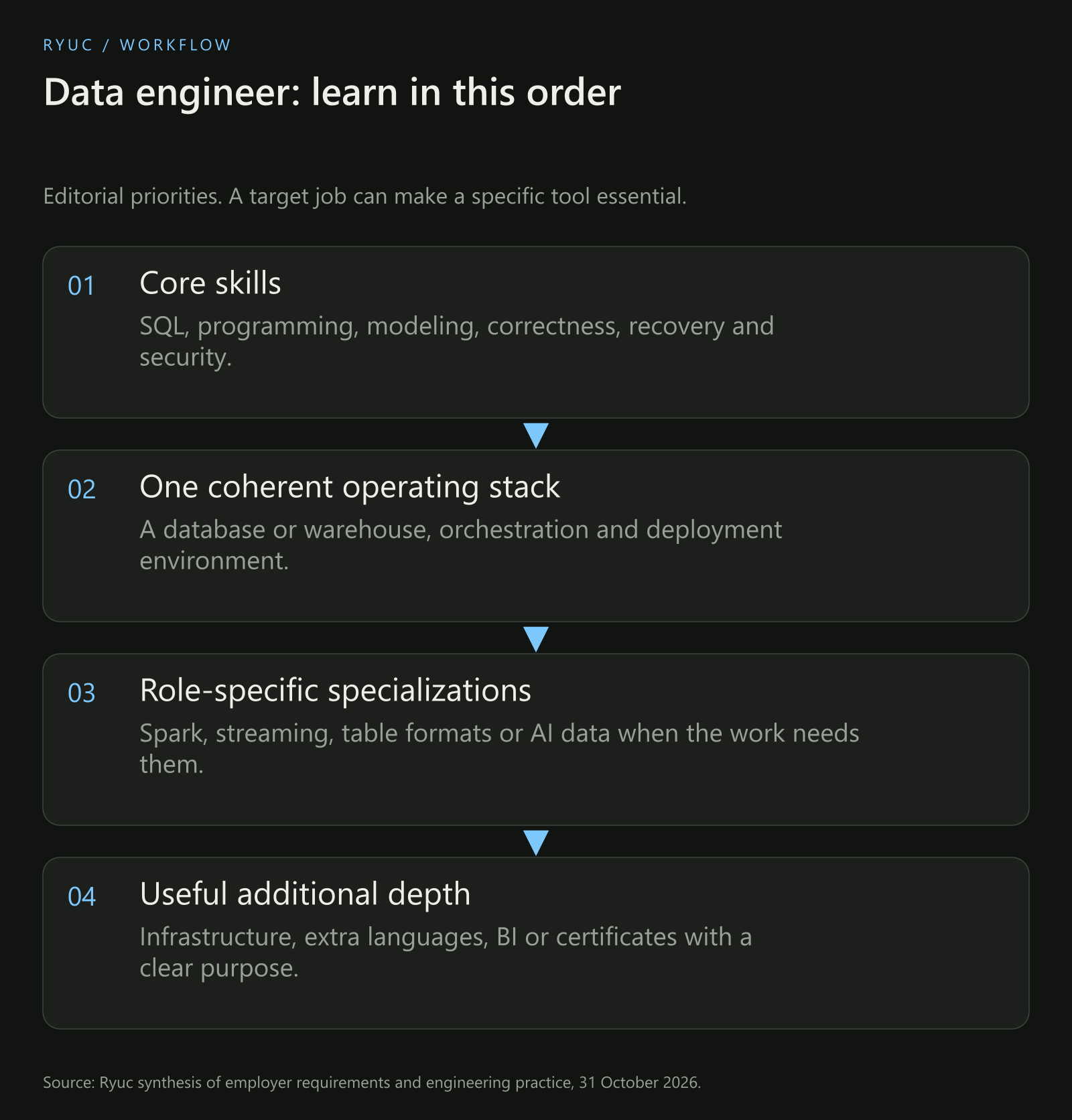
Original preparation framework. Tools move between categories when a particular job explicitly requires them.
SQL and relational reasoning
Be comfortable with joins, grouping, common table expressions, window functions, null behavior, deduplication, conditional aggregation and dates. Understand why a many-to-many join inflates a metric. Explain table grain before writing a query.
Learn to inspect an execution plan and reduce unnecessary scans or joins. Distinguish row stores, columnar analytics engines and partitioning behavior. Optimization techniques depend on the database; memorizing an index rule from one engine does not make it universal.
Proof of competence: given duplicate events, an update and a cancellation, calculate the correct latest-state metric and explain why a naive sum is wrong.
One production-capable programming language
Python is a practical starting point because it appears in the reviewed postings. Java and Scala are relevant in some ecosystems. Write functions, handle errors deliberately, manage dependencies, log useful context and test behavior. Understand generators, memory use and network boundaries well enough to avoid loading an enormous dataset into a single process accidentally.
Proof: build a paginated ingestion job that can resume, rate-limit and recover without silently skipping or duplicating data. A pandas tutorial is a useful beginning, not the entire skill.
Data modeling and business definitions
Define facts, dimensions, keys and slowly changing attributes. Distinguish event time from ingestion time and a current-state table from event history. Know how refunds, currency changes and deleted records affect a metric.
Proof: explain the grain of every table in a small model, its source of truth and how a historical correction propagates downstream.
Incremental processing and recoverability
Understand watermarks, change data capture, upserts, deduplication, tombstones, backfills and idempotency. A filter on the largest timestamp seen so far can lose late records. A successful extraction does not mean the final table commit succeeded.
Proof: replay yesterday's input and show that the result remains correct. Then add a late correction and show that the affected output changes once.
Testing, version control and basic software delivery
Use Git, code review and a repeatable environment. Test schema assumptions, uniqueness, referential integrity, allowed values and business invariants. Separate deployment credentials from source code. Understand basic CI and how to roll back a bad transformation.
Proof: make a deliberately bad input fail an appropriate check and show how an operator finds the reason. Do not automatically discard it without an agreed handling policy.
Operational and security fundamentals
Know Linux basics, logs, storage permissions, secrets and least privilege. Understand freshness, availability, lineage, retention and incident ownership. Learn enough of one operating environment to explain where jobs run, where data is stored and who can access it.
Cloud concepts are highly useful, but not every employer is cloud-only. The essential skill is operating the actual environment securely and reliably.
Tools that depend on the role and architecture
Warehouses and cloud platforms
Learn one warehouse and one deployment environment well. Examples include Snowflake, BigQuery, Redshift or a suitable SQL analytics platform; AWS, Azure and GCP each provide storage, identity, compute and monitoring services.
For an AWS-oriented role, understand the actual combination in the posting rather than collecting service names. For an Azure role, relevant services may include Azure Data Factory, ADLS, Databricks or Fabric. For a GCP role, BigQuery, Cloud Storage and Pub/Sub may matter. These are stack examples, not equivalent services or a requirement to learn every cloud.
Amazon's reviewed posting lists AWS services and big-data technologies under preferred qualifications while emphasizing SQL, modeling and ETL in the basics. Century Health makes several specific tools must-haves for its particular role. Employer-specific requirements take precedence over a generic learning guide. Amazon, Century Health.
Orchestration: Airflow, managed workflows and alternatives
Understand dependencies, scheduling intervals, retries, backfills and task state. Airflow is one implementation; managed warehouse jobs and other orchestrators can satisfy a different team's needs.
Airflow's official best practices advise designing tasks with transaction-like behavior and safe retries. Moving a watermark before the output is committed violates that principle regardless of which scheduler runs the task. Official documentation.
Transformation frameworks such as dbt
dbt is valuable where transformations and data models are expressed in SQL with tests, documentation and dependencies. Learn how incremental filters, unique keys and full refresh affect correctness. It does not remove the need to design how updates, deletes and late data are handled. Official incremental-model documentation.
Distributed processing: Spark and PySpark
Spark becomes important when the workload or employer needs distributed computation. Learn partitions, shuffles, skew, joins, lazy execution, file layout and observability. Explain why a job is slow before increasing cluster size.
You do not need a distributed cluster to deduplicate a modest local dataset. Conversely, a role explicitly requiring production PySpark is unlikely to accept only single-machine scripting experience.
Streaming, Kafka and change data capture
These matter when the business needs continuous event processing, low-latency state or change propagation. Learn event ordering, keys, consumer progress, replay, schema compatibility and delivery semantics.
Be precise about guarantees. Spark's documentation distinguishes processing modes and their guarantees. A claim about a processing engine does not automatically prove exactly-once effects in an external API or arbitrary sink. The source, sink and recovery design matter. Spark Structured Streaming.
Lakehouse formats and catalogs
Iceberg, Delta Lake and Hudi are table-format and ecosystem choices rather than interchangeable synonyms for Parquet. A columnar file format and a transactional table layer solve different problems.
For example, Iceberg's documentation explains snapshot-based reads, atomic metadata changes and optimistic concurrency. A data engineer operating such a system should understand commits, compaction, schema evolution and maintenance, not just how to write a file. Iceberg reliability documentation.
Current trends: useful directions, not automatic prerequisites
AI-assisted development
The reviewed Amazon India advertisement includes AI-native practices, and Century Health explicitly asks for active use of AI coding tools. That establishes employer examples, not a census of the Indian market. The durable requirement is reviewing generated code, validating SQL semantics and keeping restricted data out of unauthorized tools. Amazon, Century Health.
AI can help draft a transformation or a test. The engineer remains responsible when a join duplicates business facts or a generated backfill deletes valid history. Explain the checks you use to validate AI assistance.
Data infrastructure for AI products
AI systems create requirements for document ingestion, provenance, permissions, freshness, evaluation datasets and deletion propagation. A vector index is a derived data product that needs lifecycle management. Learning an embedding API is only a small part of this work.
Specialized roles can also involve multimodal data, labeling, sensor synchronization and training-dataset releases, as the robotics advertisement demonstrates. That does not make PyTorch a universal requirement for an analytics data engineer. Intelligence Factory role.
Reliability, governance and cost as product requirements
The trend is not just a different storage engine. Teams need to know who owns a dataset, how stale it can be, what an error means and what it costs to serve. A new catalog or observability product helps only when it supports an actual operating process.
Data contracts and semantic definitions can make downstream behavior more predictable. Treat them as agreements that require ownership and enforcement, not documentation files that automatically prevent changes.
Open table formats and interoperability
Understanding open table formats can be useful when an organization operates a lakehouse or wants more than one compute engine. The opportunity depends on the platform's real interoperability, catalog choices and operational constraints. Do not assume a format choice removes every migration cost or vendor dependency.
Good-to-have extras, after the core is solid
Terraform and deeper infrastructure automation: valuable when you own the deployment platform. For a transformation-focused junior role, understanding the deployment process may matter before becoming an infrastructure specialist.
Docker and Kubernetes: container literacy helps reproducibility. Cluster administration is a separate skill and is not mandatory for every data engineering job. Our Docker guide covers a useful foundation.
Scala, Java or specialized engines: choose them when the target ecosystem justifies them. Do not learn a second language merely because a roadmap lists it.
Advanced statistics, ML and model training: helpful in ML-data and experimental-data roles, but not a substitute for correct data pipelines. Domain-specific training-data work can make these essential for that job.
BI and visualization: useful for understanding consumers and checking a metric. The data engineer need not become an expert in every dashboard platform.
Certifications: can structure learning or meet an employer's partner requirement. They are weaker evidence than a project showing correctness, recovery and operating judgment. No certification guarantees a salary increase.
Legacy platforms: Hadoop, Informatica, SSIS, Oracle and other established systems remain relevant in some enterprises. They are neither universally required nor automatically obsolete. Follow the employer's operating environment and migration plans.
A worked example: duplicates, late corrections and current-state metrics
Suppose an order-event source delivers these synthetic records: order A is paid and later cancelled; order B's paid event arrives twice; order C is paid once. A naive sum across the paid rows counts both B events and ignores A's later cancellation.
The transformation must define its grain as one current record per order, choose a trustworthy source version and then apply the status filter. One illustrative SQL pattern is:
WITH ranked AS (
  SELECT
    order_id,
    source_version,
    status,
    amount_paise,
    ROW_NUMBER() OVER (
      PARTITION BY order_id
      ORDER BY source_version DESC, ingested_at DESC
    ) AS version_rank
  FROM raw_order_events
)
SELECT COALESCE(SUM(amount_paise), 0) AS current_paid_paise
FROM ranked
WHERE version_rank = 1
  AND status = 'paid';
The synthetic fixture uses A paid at 10,000 paise then cancelled, B paid at 20,000 paise delivered twice, and C paid at 5,000 paise. The expected latest-state result is 25,000 paise, or ₹250, compared with a naive paid-row sum of 55,000 paise, or ₹550. The companion verification checks this arithmetic in SQLite, including duplicate replay and an older late-arriving version.
The example assumes a meaningful source-version ordering and consistent currency. If the source does not provide that ordering, specify a different authoritative conflict rule. Conflicting rows with equal ordering values must be detected rather than resolved by accident.
This query alone is not a complete incremental pipeline. Production work must also decide which changed order IDs to recompute, how to apply cancellations or tombstones, how to publish atomically and when to advance its checkpoint.
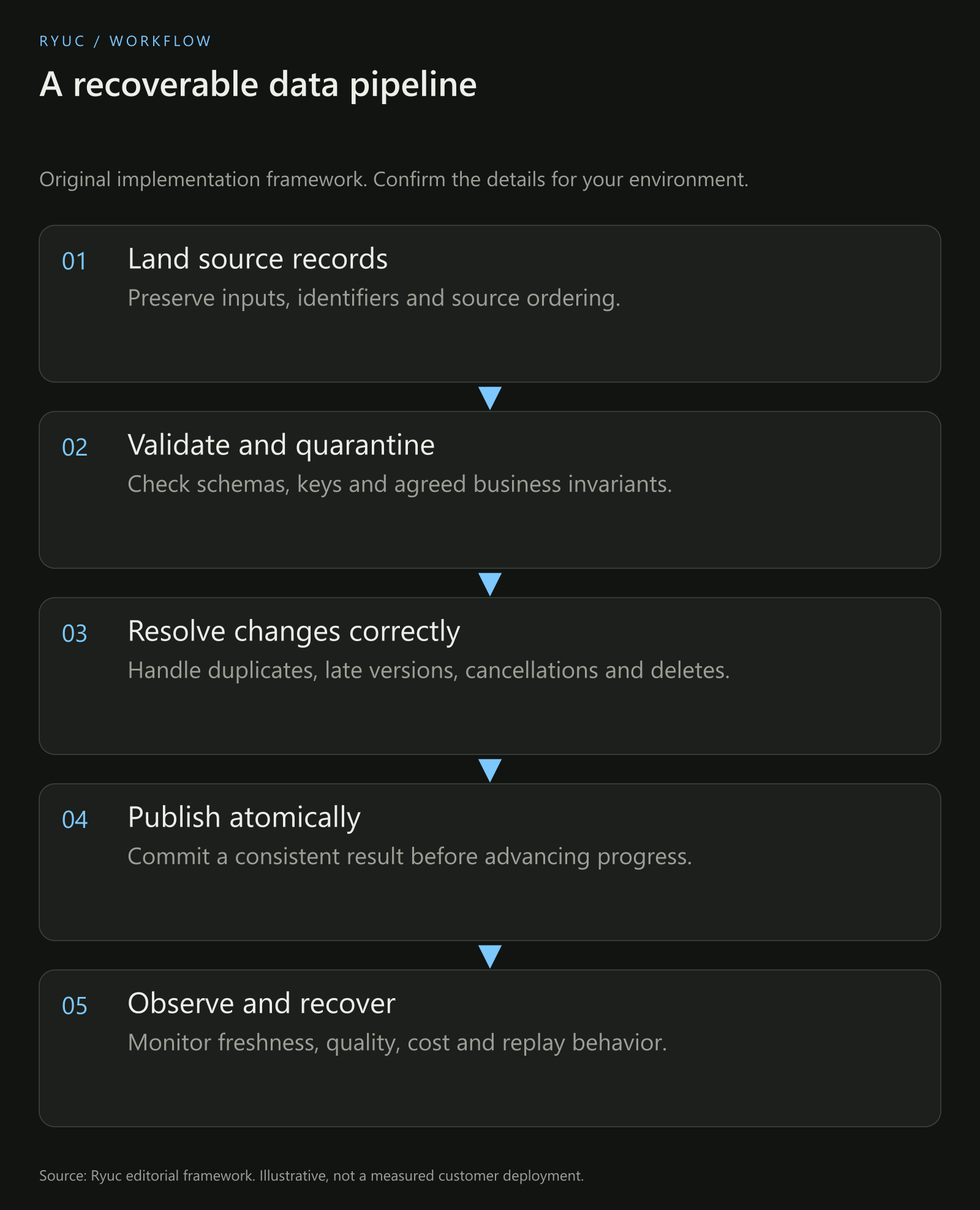
Original architecture exercise. The included SQL is tested on synthetic SQLite data, not a benchmark of a cloud warehouse or a complete production pipeline.
Build one project that proves the right skills
A useful portfolio project can run locally with Python, a SQL database and a simple scheduler, then add a cloud deployment if needed. Choose synthetic commerce or service events rather than private customer records.
Require it to ingest incrementally, retain raw inputs, validate schema and keys, deduplicate changes and publish a documented current-state model. Include a late update, a cancellation, duplicate input, a failed run and a backfill. Show the output after replay.
Add an operational record: the freshness target, job logs, quality checks, an incident runbook and a simple cost estimate. Document where the design stops. A clear single-node project can demonstrate more judgment than a large collection of managed services connected without recovery behavior.
When applying to a Spark role, extend the same problem to a distributed workload and explain partitioning and skew. For a streaming role, add event-time behavior and replay. For an AI-data role, add provenance, permissions and freshness to a document or training-data pipeline. Let the target role determine the specialization.
A realistic learning order
First: SQL, Python, relational modeling, Git and one reproducible pipeline. Learn to explain correctness before adding scale.
Next: incremental loading, retries, backfills, data quality, orchestration and operational monitoring. Operate the project long enough to encounter failures you can explain honestly.
Then: one warehouse and one cloud or enterprise environment relevant to your target jobs. Learn storage, identity, compute, billing and deployment together.
Finally: specialize in Spark, streaming, lakehouse operations, AI data infrastructure or platform automation when that work appears in the positions you want.
For interviews, prepare one SQL debugging example, one modeling trade-off, one recovery scenario, one cost/performance investigation and one conversation where you clarified a business definition. The behavioral questions guide can help present real experience clearly.
Ask employers about on-call duties, data volume, freshness requirements, current failure modes, warehouse costs, team ownership and whether the role mainly builds, supports or migrates systems. “Modern stack” is less informative than a clear operating model.
Your next steps
- Match salary comparisons to location, level and compensation definition.
- Master SQL, programming, modeling and recoverable pipelines before collecting tools.
- Learn one coherent stack required by the jobs you are targeting.
- Add trends and optional extras when they solve a specific workload problem.
- Demonstrate correctness, replay, failure recovery and business communication in one project.
Download the India data engineer skills and offer worksheet.
Frequently asked questions
Is Spark mandatory for every data engineer in India?
No. Some roles explicitly require production Spark or PySpark and should be prepared for accordingly. Others rely mainly on SQL warehouses, smaller batch workloads or managed systems. The general requirement is choosing and operating the appropriate processing approach.
Should I learn AWS, Azure and GCP together?
Usually start with one coherent environment matched to target jobs. Learn the underlying storage, identity, compute and monitoring concepts so you can transfer them later. Superficial familiarity with all three is weaker than real operating ability in one.
Are SQL and Python enough to get hired?
They are a strong foundation, but the evidence needs to include modeling, quality, incremental processing and operational judgment. The actual employer may also require specific cloud, Spark, dbt or streaming experience.
Will AI remove the data engineer role?
AI changes how code and analysis are produced, but reliable source data, permissions, definitions and recovery remain necessary. That does not guarantee every current job will remain unchanged or hiring will always rise. Build transferable ownership rather than relying on a particular title.
What should a fresher use as a salary expectation?
Use current junior employer budgets and comparable locations first. Payscale's reviewed under-one-year cohort reports about ₹5.18 lakh average total compensation, but it is a limited survey cohort rather than a guaranteed offer. A specialized startup advertisement should not become the default expectation for every fresher.
Sources
- Amazon India Data Engineering and Analytics employer posting.
- Payscale India Data Engineer compensation, updated 9 October 2026.
- Glassdoor India Senior Data Engineer compensation, captured 31 October 2026.
- Century Health, employer-authored data engineer advertisement.
- Senzcraft, employer-authored GCP data engineer advertisement.
- Intelligence Factory, employer-authored India data engineer advertisement.
- Apache Airflow official best practices.
- dbt official incremental-model documentation.
- Apache Spark official Structured Streaming guide.
- Apache Iceberg official reliability documentation.