Behavioral interview questions ask for evidence from something you have done. The strongest preparation is a set of truthful examples you understand well enough to explain under follow-up questions.
Short answer: Describe the situation briefly, make your own responsibility clear, explain your actions and state the result without exaggeration. Use sample answers to understand structure, then replace the story with your own facts.
Method: The fifteen answers below are original fictional examples, not accounts you should claim as your own. They illustrate STAR: situation, task, action and result. Official career guidance recommends using your own experience and avoiding memorized AI scripts. Source: Harvard career services.
Questions about teamwork and disagreement
1. Tell me about a time you disagreed with a teammate.
Example answer: In a student project, we disagreed about adding another feature before the demo. I was responsible for testing and was concerned about an unresolved login bug. I showed the failure and proposed fixing it before adding scope. We agreed on a smaller demo, documented the postponed feature and completed the presentation with the core flow working. I learned to explain the tradeoff rather than argue from preference.
Prepare for: What did the teammate disagree with, and what would you do if they still preferred the other option?
2. Describe a difficult collaboration.
Example answer: A group assignment had overlapping tasks and unclear ownership. I was handling the report, but changes kept arriving after I had formatted it. I proposed a shared task list, a review cutoff and one owner for each section. That made the remaining work easier to coordinate. I would set those expectations earlier next time instead of waiting for the handoff to become a problem.
3. Tell me about a time you helped someone succeed.
Example answer: A classmate was struggling to run our project locally. I had already resolved the same setup issue, so I walked through the steps and wrote a short setup note. They were then able to test their contribution independently. The useful result was not just fixing one machine; we had instructions the next teammate could follow too.
Questions about mistakes and learning
4. Tell me about a mistake you made.
Example answer: I merged a change after checking only the normal input. A teammate found that an empty input caused an error. I reproduced it, fixed the condition and added an explicit test for the missing case. I also told the group what I had missed. The experience changed my review checklist: I now ask about empty, invalid and boundary inputs before calling a change ready.
5. Describe a time you received difficult feedback.
Example answer: A mentor said my project explanation listed tools without explaining the problem. I initially thought the detail showed preparation, but I asked which part was unclear. I rewrote the explanation around the user's need, my contribution and one decision. In the next review, the discussion moved to the design tradeoff rather than basic clarification. I learned to ask for an observable example when feedback feels broad.
6. Tell me about a time you had to learn something quickly.
Example answer: Our prototype needed a simple API integration I had not used before. I identified the smallest required operation, read the official documentation and tested it with sample data. I asked a more experienced teammate to review the error handling before we integrated it. I did not become an expert immediately, but I completed the bounded task and documented what remained uncertain.
7. Describe a goal you did not meet.
Example answer: I planned to finish a project extension during the semester but underestimated the time needed to understand the existing code. I completed the core assignment but did not deliver the extension. I explained the gap in our review and kept the unfinished work separate from the completed result. For the next project, I included an investigation task before committing to the full scope.
Questions about ownership and priorities
8. Tell me about a time you took initiative.
Example answer: During a club event, volunteers repeatedly asked where to find the latest schedule. I was not the event lead, but I noticed the same information was being sent in several chats. I checked the schedule with the organizer and created one clearly labelled reference. That reduced conflicting instructions during the event. I made sure the organizer remained responsible for approving changes.
9. How did you handle competing deadlines?
Example answer: Two assignments and a team demo were due in the same week. I listed the required outputs, checked dependencies and told the team when I could complete my part. I finished the task blocking another teammate first, then worked through the independent assignments. I also reduced optional demo scope with the group's agreement. The key was making priorities and tradeoffs visible early.
10. Tell me about an ambiguous task.
Example answer: I was asked to make a dashboard easier to use, but the request did not specify the problem. I asked who used it and what decision they needed to make. We discovered that the main issue was finding overdue items, not the overall visual style. I proposed a focused change and checked it with the requester before implementation. That avoided redesigning unrelated screens.
11. Describe a time you had to say no or renegotiate scope.
Example answer: A requested feature would have added an external dependency shortly before a demo. I explained the setup and testing work it required and offered two options: a smaller version for the demo or the full feature later. The project lead chose the smaller version. I learned that a useful objection includes an alternative and a clear consequence, not just a refusal.
Questions about judgment and communication
12. Tell me about a time you explained something technical to a nontechnical person.
Example answer: A club organizer wanted to know why our registration form could not simply email every entry to everyone. I explained who needed the data and what unnecessary sharing would expose. I used the actual registration process rather than database terminology. We agreed on a smaller set of recipients and a summary for the wider team. I checked that the organizer understood the operational tradeoff.
13. Describe a decision you changed after seeing new evidence.
Example answer: I thought a slow page needed a new library, but a basic inspection showed that we were repeatedly loading the same large asset. I measured the relevant request, discussed the finding and changed the plan to address that cause first. The experience reminded me to investigate the observed problem before choosing a larger solution. I would not claim the original idea was right after the evidence changed.
14. Tell me about a time you raised a concern.
Example answer: Before a demo, I noticed our sample document contained a real person's contact details. I raised it privately with the project lead and suggested using fictional data instead. We replaced the document and checked the remaining demo materials. I focused on the specific issue and a practical correction rather than blaming the person who uploaded it.
15. What accomplishment are you proud of?
Example answer: I am proud of making our project reproducible for the rest of the group. I organized the setup instructions, identified required configuration and checked the steps on a clean environment available to us. The result was that another teammate could start contributing without relying on my machine. It was less visible than adding a feature, but it addressed a real obstacle for the team.
How do you turn an example into your own answer?
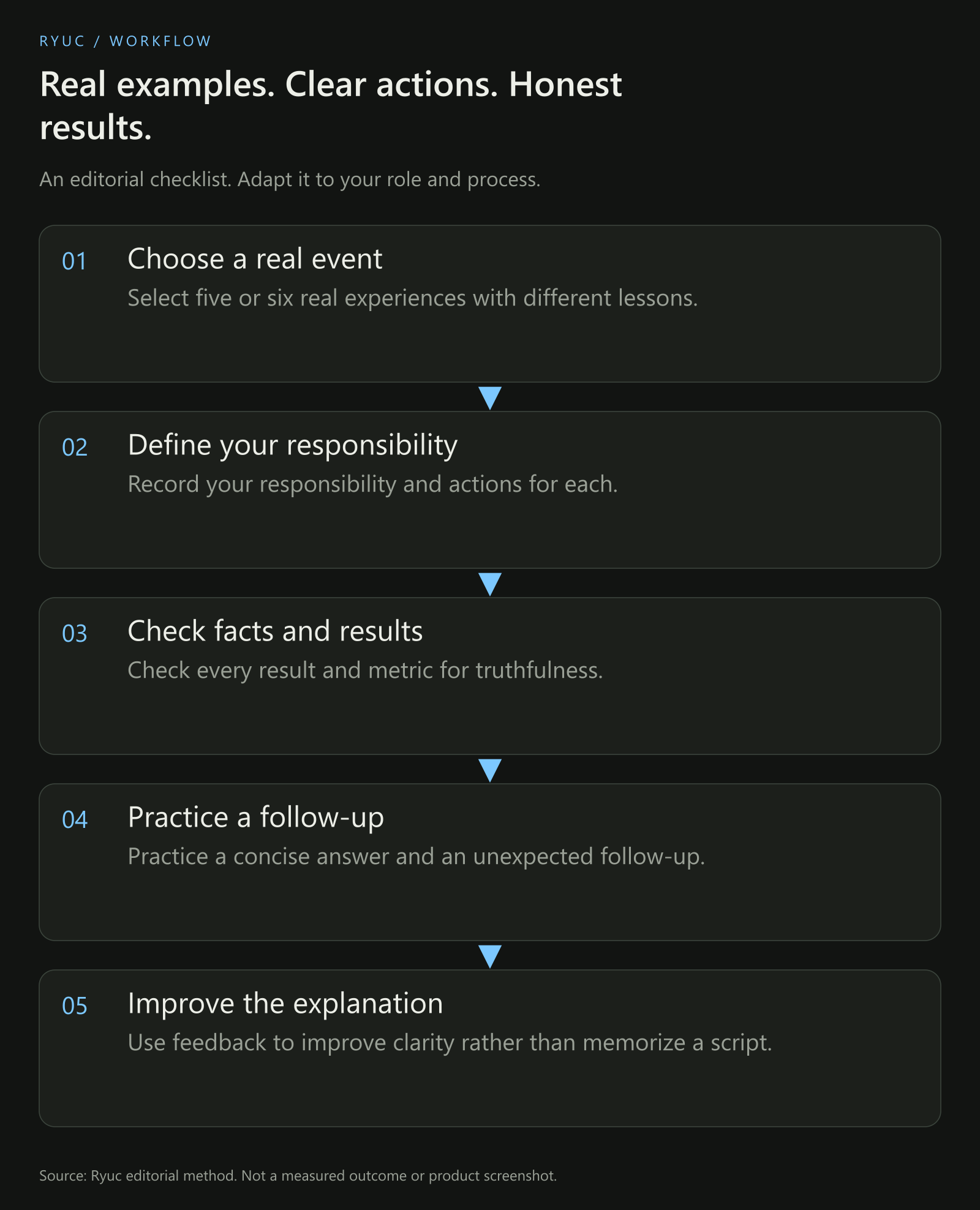
Original preparation method. The sample stories are fictional teaching examples.
Choose a real event first. Write down what was happening, what you were responsible for and what you actually did. Use evidence you can explain; a result can be a completed task, a corrected mistake or a clear lesson. It does not require an impressive percentage.
Keep the context short enough that the interviewer can understand your actions. Make the difference between “we” and “I” clear without taking credit for someone else's work.
Prepare for an unsuccessful example too. A truthful account of what went wrong and how you responded is more useful than a fake story in which every outcome was perfect.
What should you avoid?
Do not turn a weakness question into a disguised boast. Do not blame a teammate without explaining your own choices. Do not attach invented numerical results to make an answer sound measurable.
If you have no relevant example, say so and offer the closest honest one. A hypothetical response can be useful when requested, but label it as hypothetical rather than presenting it as past experience.
For a more general preparation conversation, see our internship questions and HR-round answers.
Your next steps
- Select five or six real experiences with different lessons.
- Record your responsibility and actions for each.
- Check every result and metric for truthfulness.
- Practice a concise answer and an unexpected follow-up.
- Use feedback to improve clarity rather than memorize a script.
Download the behavioral-answer checklist.
Frequently asked questions
Can a fresher use a college project?
Yes. Explain its actual context and your contribution. Coursework, clubs, volunteering and personal projects can provide useful examples. Do not imply that a classroom project was paid commercial work.
Must every answer end with a numerical result?
No. Use a number when you have an accurate, relevant one. A completed handoff, corrected error or change in process can be a meaningful result if you explain it concretely.
Can I use the same example for several questions?
Sometimes, but prepare more than one story so you can address the actual question. Do not force every question into an example that does not demonstrate the relevant behavior.
Sources and method
- Harvard career services: AI for Interviews and Offers
- All sample scenarios and wording are original fictional editorial examples.