An internship interview often asks how you learn, work with others and apply what you know. You do not need to pretend you already have years of professional experience. You need to explain your current evidence and what you are ready to learn.
Short answer: Prepare a clear introduction, a few real projects or activities, basic knowledge relevant to the role and practical details about your availability. The twenty questions below apply across many internship types; adapt the technical detail to the opportunity.
Method: These are editorial practice questions with fictional example answers and answer outlines. They are not a verified list from a named employer. Use truthful details from your own experience.
Background and motivation
1. Tell me about yourself.
Example answer: I am studying engineering and have been exploring how software can solve everyday coordination problems. In a recent group project, I worked on the registration flow and learned to test edge cases. I am looking for an internship where I can contribute to a real team and improve how I design and review my work.
Keep the introduction relevant rather than reciting your entire resume.
2. Why do you want this internship?
Explain the connection between the work described and a real interest or learning goal. For example: I want experience turning a small prototype into something other people can use, and this role's emphasis on testing and team review matches that goal. Avoid claiming knowledge of the company's internal work you do not have.
3. What do you know about our organization?
Use current official information about its product, customers or mission. Then identify a question you still have. An honest answer can say that you understand the public product but would like to learn how this team contributes to it. Do not repeat unsupported facts generated by AI.
4. Why this field or role?
Connect interest to an activity. For a marketing internship, discuss a campaign or club communication you helped create. For engineering, explain a problem you enjoyed investigating. Interest becomes easier to evaluate when you show what you have already tried.
5. What would you like to learn?
Example answer: I want to learn how a team decides what is ready to ship. I have built projects in class, but I have less experience with review, deployment and monitoring. I would like to contribute to a bounded task while learning those practices from the team.
Projects and problem-solving
6. Tell me about a project you worked on.
Explain the problem, your contribution, one decision and how you checked the result. A small project described clearly is better than a large title with vague ownership. Expect a follow-up about the part you personally built or analyzed.
7. What was the hardest part?
Choose a real difficulty and show your process. For example: Our data had inconsistent categories, so I first checked which values appeared and agreed on a mapping with the team. Describe what you learned rather than simply saying the project was challenging.
8. What would you improve now?
Name a specific limitation and an appropriate next step. Example: I would add clearer input validation and a small set of tests before expanding the feature list. Our demo handled the normal path, but I now understand that invalid input needs an explicit response.
9. How would you approach a task you have never done?
Explain how you clarify the outcome, identify a small first step, consult reliable material and ask for review. Do not promise that you can figure out everything alone. Knowing when to ask for help is part of working responsibly.
10. What do you do when you do not know an answer?
Example answer: I would state what I know, identify the missing part and explain how I would check it. If the task affects someone else's work, I would raise the uncertainty before acting. I would rather verify a detail than present a guess as a fact.
Teamwork and learning
11. How do you work in a team?
Use an example involving ownership, communication or a handoff. Explain how you make your progress and blockers visible. Avoid describing yourself only with adjectives such as hardworking or cooperative; show an action that supports the description.
12. Describe a disagreement.
Explain the competing ideas and how you assessed them. A useful answer might describe comparing options against a deadline or requirement, then agreeing on a smaller scope. Do not make the story depend on everyone else being wrong.
13. Tell me about feedback you received.
Choose feedback that changed your work. State what the reviewer observed, what you changed and what remained to improve. Our behavioral interview guide includes longer fictional examples of this structure.
14. How do you manage coursework and deadlines?
Describe your real planning method and how you communicate conflicts. Example: I list the required deliverables, check which tasks depend on another person and flag conflicts early. If I cannot meet a commitment, I explain the impact and propose a revised plan instead of disappearing.
15. What is a skill you are still developing?
Choose a relevant, honest gap and a concrete practice habit. Example: I am improving how I explain technical decisions. I can implement a solution, but I sometimes give too much context before the main point. I now practice a short explanation and ask a classmate to identify what was unclear.
Practical fit and expectations
16. What can you contribute as an intern?
Connect a demonstrated skill to a bounded task. You might contribute careful research, a small implementation, documentation or analysis. Avoid promising to transform the department before understanding its work.
17. When are you available, and for how long?
Give accurate dates, academic constraints and working-hour limitations. If an exam schedule is not final, say so and explain when you expect confirmation. Do not agree to an arrangement you already know you cannot meet.
18. Are you comfortable with the working location or arrangement?
State what you can actually do and ask about unresolved requirements. Remote, hybrid and on-site arrangements can involve different hours and access needs. Clarify them rather than assuming that the label answers every practical question.
19. What are your expectations for the internship?
Discuss the work, learning, feedback and practical conditions you need to understand. Example: I would like a clearly scoped contribution, access to feedback and an understanding of how my work will be reviewed. Could you explain the project and support arrangement for this internship?
20. Do you have questions for us?
Ask about the project, onboarding, supervision, review process or remaining stages. Choose a question that has not already been answered. Our end-of-interview question guide includes options for interns and freshers.
How should you practice these questions?
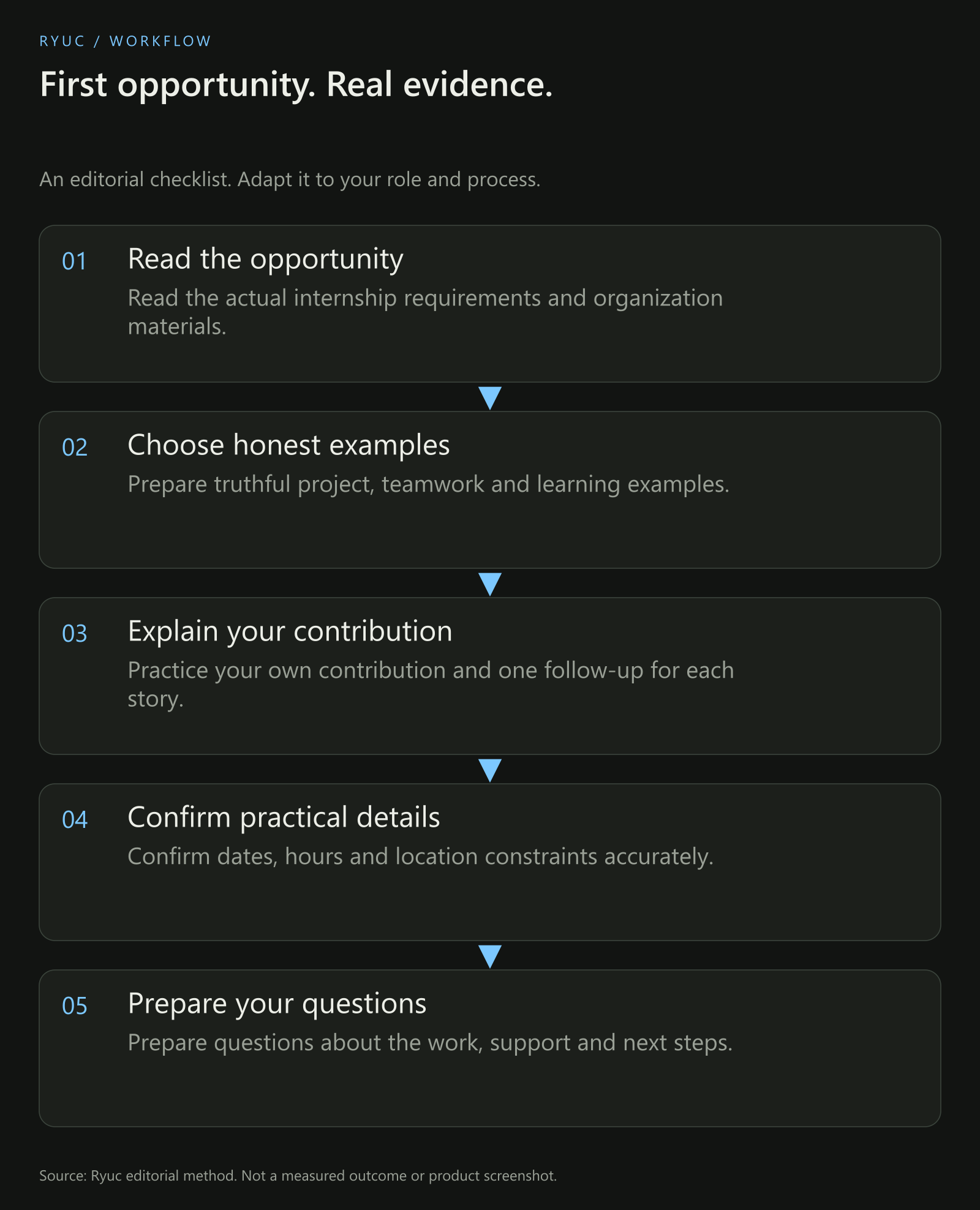
Original practice sequence. It does not predict a particular employer's interview.
Select a real posting and identify the skills it asks for. Prepare a few examples, then ask a peer to choose questions in a different order and add follow-ups. Do not read the answer while practicing the final version.
Official career guidance describes interviews as a chance for both the organization and applicant to evaluate fit. Use the discussion to understand the internship too. Source: Harvard career services.
For campus preparation, read the Indian engineering student mock-interview guide. Technical roles may also need focused practice beyond these general questions.
Your next steps
- Read the actual internship requirements and organization materials.
- Prepare truthful project, teamwork and learning examples.
- Practice your own contribution and one follow-up for each story.
- Confirm dates, hours and location constraints accurately.
- Prepare questions about the work, support and next steps.
Download the internship preparation checklist.
Frequently asked questions
What if I have never had a job?
Use coursework, volunteering, clubs or personal projects, and state their context honestly. An internship interviewer can evaluate how you learn and contribute without every example coming from employment.
Should every answer be technical?
No. General questions explore motivation, teamwork, learning and practical fit. Technical depth should match the role. Prepare to explain relevant work, but do not force unrelated technical detail into every answer.
Is it acceptable to ask for clarification?
Yes, when it helps you answer the actual question. Ask a focused clarification, then respond. Do not use uncertainty as a reason to invent a fact or avoid explaining what you do know.
Sources and method
- Harvard career services: Prepare for an Interview
- The questions and example answer wording are original editorial practice material.