An engineering student can understand a project and still struggle to explain it in an interview. The gap often becomes visible only when someone asks an unexpected follow-up: Why that database? What did you personally build? What failed during testing?
Short answer: Mock interviews give Indian engineering students a low-stakes place to practice explaining real work, answering follow-ups and receiving specific feedback. The useful habit is answer, review, correct and retry, not memorizing a collection of polished scripts.
Method: This is an original practice plan informed by official career-preparation and assessment guidance. The schedule is a suggested routine, not a tested placement guarantee. You can use it with peers, mentors or an appropriate AI tool.
Why is practice useful before campus placements?
Placement preparation often divides into aptitude practice, technical study and interview preparation. Those tasks overlap, but solving a problem privately is different from explaining a decision while someone asks questions.
A mock interview helps reveal the missing link. You may know the definition of an API yet struggle to describe the API in your own project. You may have contributed to a team assignment but describe only what the team did.
The aim is to make your actual evidence understandable. It is not to imitate a particular accent or pretend to have professional experience you do not possess.
What should a fresher prepare first?
Choose two projects or meaningful activities you can discuss in detail. For each, record the problem, your contribution, one decision, one difficulty, how you checked the result and what you would improve.
An academic project, lab exercise, club responsibility or volunteering example can provide useful evidence if it is described honestly. Say what it was and what you personally did. Do not relabel a class assignment as a commercial client engagement.
Prepare a concise introduction that connects your studies and evidence to the role. Our internship questions guide includes general examples you can adapt.
What should a mock interview include?
Use a short sequence: introduction, project explanation, a role-related question, one behavioral example and questions for the interviewer. Add a follow-up that changes a constraint or asks for a concrete example.
For a React role, ask why a component needs state and what happens when a list's keys change. For a general internship, ask how the student learned a new task or coordinated work with someone else. Match the exercise to the opportunity rather than copying a senior engineer's interview loop.
OPM's assessment guidance links questions to job-related competencies and comparable rating standards. That is a useful principle for deciding what feedback to give during a mock. Source: OPM.
How should you give feedback?
Original practice plan. No placement or score improvement is promised.
Choose a small number of feedback criteria: relevance, specific evidence, clear ownership and reasoning. Tell the student what was unclear and what would make the answer easier to evaluate.
Avoid vague labels such as low confidence. A more useful note is “You explained the team outcome but did not say which part you built.” That gives the person something concrete to fix.
Do not confuse language fluency with technical understanding. Practice clear communication while keeping the feedback connected to the actual requirements of the role.
Can AI help with mock interviews?
It can generate follow-ups and critique an answer's structure. Official Harvard career guidance suggests using generative AI for interview preparation and feedback, including STAR-structured responses. That is preparation guidance, not approval for undisclosed help in an employer's assessment. Source: Harvard career services.
Act as a practice interviewer for an entry-level role. Ask one question at a time about the project I describe. After my answer, ask one neutral follow-up about my own contribution or reasoning. Then give feedback on relevance, specific evidence and clarity. Do not invent achievements or treat accent as ability.
This is an editorial practice prompt. Check technical feedback against reliable material and a knowledgeable reviewer when needed.
What could a two-week practice plan look like?
In the first few days, prepare your project evidence and record a short introduction. Use the next sessions for one project explanation and one follow-up at a time. Keep an error log of facts you need to revise and explanations that remain unclear.
In the second week, combine the pieces into a short mock, then practice a variation without reading notes. Review one or two weaknesses after each session instead of attempting to perfect every answer at once.
This is a proposed schedule, not a rule that every student needs fourteen days. Fit the routine around coursework, access and the actual placement timeline. Regular focused practice can be more useful than repeatedly performing the same script.
How can students practice without an expensive subscription?
Pair with a classmate and alternate interviewer and candidate roles. Share the role description and a small feedback rubric. Ask a faculty member, alumnus or placement mentor to review an occasional session if that support is available.
Use permitted free tools selectively. A paid product's testimonial does not establish that buying it is necessary for placement. Compare what you learn from the session rather than the number of generated answers.
Platforms such as Superset can be relevant to placement coordination and preparation, but read the actual opportunity and institution instructions. Preparation features and employer assessment rules are separate.
What should you avoid?
Do not memorize claims you cannot defend, invent metrics or rehearse an answer so rigidly that a follow-up becomes impossible. Do not use a practice tool secretly in a restricted assessment.
Avoid practicing only definitions. Include a small scenario, a debugging explanation or a discussion of a decision from your project. Our React questions and Docker questions can help identify concepts to explain aloud.
Also prepare questions for the employer. An interview helps you understand the role, supervision and expectations; it is not only a test of your ability to produce answers.
Your next steps
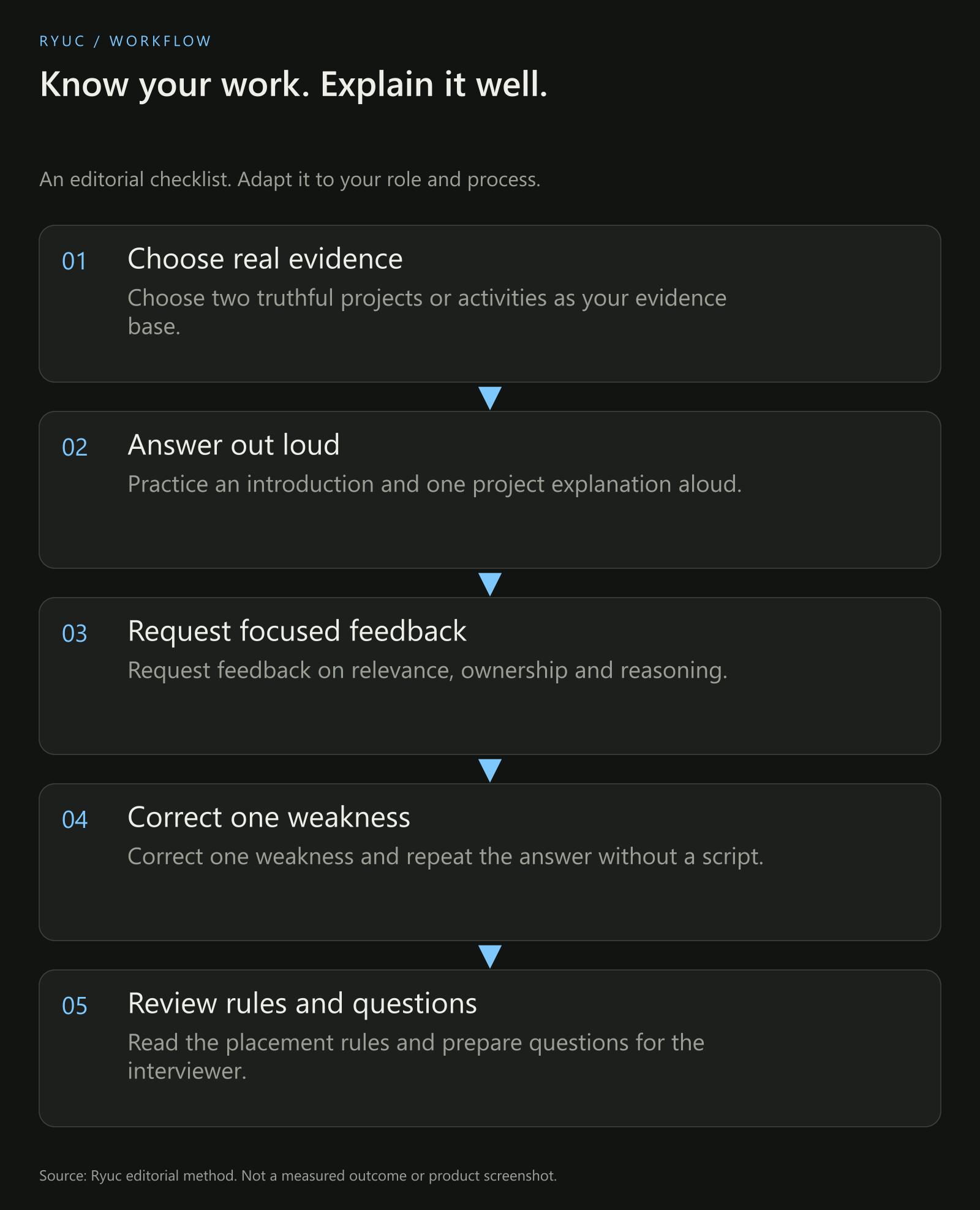
- Choose two truthful projects or activities as your evidence base.
- Practice an introduction and one project explanation aloud.
- Request feedback on relevance, ownership and reasoning.
- Correct one weakness and repeat the answer without a script.
- Read the placement rules and prepare questions for the interviewer.
Download the student mock-interview checklist.
Frequently asked questions
Do freshers need professional experience for behavioral answers?
No. Use an honest example from coursework, a project, a club or another real activity. Explain its context and your own actions. Do not make the example sound like paid employment if it was not.
Should I memorize sample answers?
Use them to understand structure, then build an answer from your own facts. Practice follow-ups and variations. Memorizing someone else's achievement makes it harder to demonstrate genuine understanding.
Can mock practice guarantee placement?
No. It can help you prepare and reveal gaps, but outcomes depend on the opportunity, requirements and employer process. Treat feedback as a way to improve your evidence and explanations, not a promise of an offer.