When an interviewer asks whether you have questions, use the time to investigate the job. You do not need a clever question that makes you sound impressive. You need information that helps you understand the work, expectations and next steps.
Short answer: Prepare several relevant questions, then choose two or three that the conversation has not already answered. Ask the person who can actually answer them and use a short follow-up when their response is unclear.
Method: The twenty questions below are original editorial examples. They are not a survey of questions guaranteed to impress employers. Career guidance supports preparing for a two-way discussion; the specific wording should fit your situation. Source: Harvard career services.
Questions about the role
1. What would you want the person in this role to accomplish in the first three months?
This helps turn a broad job description into an outcome. If the answer contains several priorities, ask which one matters most. For an internship, ask what a realistic first contribution would look like rather than assuming you will own a major project immediately.
2. Which problem is the team hiring this person to solve?
The vacancy may reflect growth, a replacement or a specific gap. Understanding the problem helps you judge whether your experience and interests fit. Ask neutrally; you do not need to imply that something is wrong with the team.
3. What does a typical week involve?
Ask about the balance between planned work, meetings, support and unexpected requests. A title alone does not reveal that balance. If the interviewer gives a general answer, ask for a recent example of the work someone in the role handled.
4. What is the hardest part of succeeding in this role?
This can reveal constraints that did not appear in the advertisement. Listen for concrete examples and the support available. The purpose is to understand the challenge, not to demand that the interviewer list every difficulty in the organization.
Questions for the hiring manager
5. How do you set priorities when several requests compete?
This explores how work decisions are made. A useful answer may describe an owner, a planning rhythm or an escalation route. You can follow up by asking how a new team member should raise a conflicting deadline.
6. How do you give feedback during someone's first few months?
Ask about frequency and format, not just whether feedback exists. For a fresher, regular review may be especially useful. For an experienced applicant, the answer can show how autonomy and accountability are balanced.
7. How will my work be evaluated?
Look for expectations connected to the actual work. If the answer is vague, ask what a strong first review would cite as evidence. You are seeking clarity, not trying to negotiate a performance rating before joining.
8. What decisions would I own, and which would need review?
This helps establish the practical scope of the role. In an engineering interview, it might reveal code-review or release responsibilities. In another role, it may clarify client commitments, budget approval or operational escalation.
Questions for potential teammates
9. How does the team share context when work moves between people?
This is useful in any collaborative role. Ask about documentation, handoffs and how someone finds help. A recent example is often more informative than a general statement that the team communicates well.
10. What does a useful code review or work review look like here?
Adapt the wording to the profession. You are investigating how quality is checked and how people learn from feedback. Listen for process and examples rather than assuming a particular tool proves good practice.
11. What is something you wish you had known before joining?
This gives a teammate room to discuss practical context. Respect the person's boundaries and do not push for confidential details or criticism of colleagues. Ask a follow-up only when it helps clarify the role.
12. What has changed in the team's way of working recently?
This can reveal how the team responds to growth, new tools or changing priorities. It is especially useful when the job description sounds stable but the organization is evolving quickly.
Questions for freshers and internship applicants
13. Who would help me get started, and how is onboarding organized?
Ask about the actual support arrangement rather than expecting a dedicated mentor in every organization. A useful answer may explain documentation, review sessions, a buddy or a manager's role.
14. What knowledge should I have on day one, and what can I learn after joining?
This distinguishes entry requirements from development opportunities. It also helps you prepare realistically. Do not use the question to avoid an essential requirement already stated in the role description.
15. What kind of project would an intern or new graduate contribute to?
Ask for an example and how the work is scoped and reviewed. This is more useful than asking only whether the work will be interesting. For internships, clarify whether the work has a defined learning or delivery goal.
16. Is there a review at the end of the internship, and what does it assess?
This can help you understand feedback and any conversion process. Do not treat the existence of a review as a guaranteed full-time offer. Ask how the process works and what conditions apply.
Questions for HR or the recruiter
17. What are the remaining stages and expected timeline?
This is a practical question about planning. If the process includes another assessment, ask its purpose and expected time. Our interview-fatigue guide explains why clarity about the whole loop matters.
18. Is there anything else you need from me to complete this stage?
This gives the recruiter a chance to identify a missing document or clarification. It is more actionable than repeatedly asking whether you passed. Follow the stated process for sending any additional information.
19. Could you explain the working arrangement and any location requirements?
Use the question when those details are unresolved. Clarify what the role requires rather than assuming that remote, hybrid or flexible means the same thing at every company. Ask about compensation or benefits when relevant and with the person responsible for them.
20. What is the best way to follow up if the timeline changes?
This establishes a communication route and avoids repeated messages to several people. Respect the answer and any stated waiting period. A useful follow-up refers to the agreed stage and timing.
How do you choose the right questions?
Original interview-preparation method, not a claim about employer preferences.
Choose questions whose answers affect your understanding or decision. Do not ask something only because it appears on a list. If the interviewer already explained onboarding, move to an unresolved issue rather than reading the prepared question anyway.
Ask one question at a time. A long sequence about culture, promotion, compensation and workload makes it difficult to obtain a useful answer. A short follow-up about a concrete example is often better.
What if you only have one minute?
Choose the highest-priority gap. For a hiring manager, the first-three-months question is often a useful way to clarify expectations. For a recruiter, the remaining-stages question may be the practical priority. These are editorial suggestions, not universal rules.
If you need more time, ask whether you can send a short follow-up through the agreed contact. You do not have to force every question into the final minute.
Your next steps
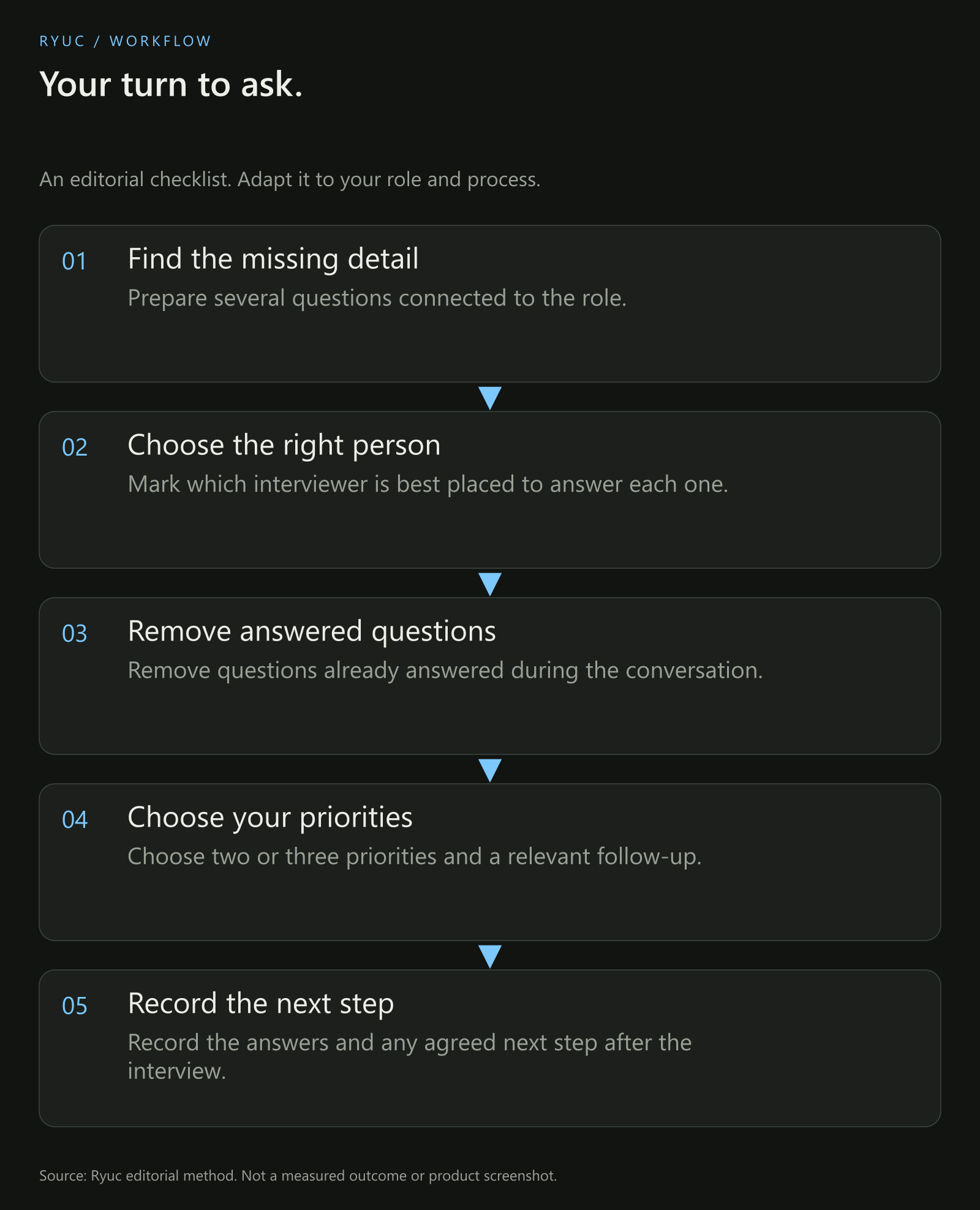
- Prepare several questions connected to the role.
- Mark which interviewer is best placed to answer each one.
- Remove questions already answered during the conversation.
- Choose two or three priorities and a relevant follow-up.
- Record the answers and any agreed next step after the interview.
Download the end-of-interview question checklist.
Frequently asked questions
Is it bad to say all my questions were answered?
You can say so honestly and briefly mention the information that helped. You do not need to invent a question. Preparing several options makes it easier to identify a useful unresolved point when time permits.
Can I ask about salary?
Compensation can be relevant to deciding whether an opportunity fits. Ask the appropriate recruiter or HR contact and consider what has already been communicated. There is no single rule that every employer follows about timing.
Should I ask whether I will get the job?
The interviewer may not be able to answer immediately. Asking about remaining stages, required information and timing is usually more actionable. Avoid treating an informal reaction as an official decision.