Interview fatigue can develop when candidates repeat the same information across forms, recordings, automated conversations and human rounds. Recruiters can experience a parallel problem: a calendar full of conversations that produce little new evidence.
Short answer: Give every stage a clear purpose, carry useful evidence forward and remove repetition. Introducing AI should simplify an assessment or improve its evidence, rather than automatically adding another gate.
What we verified: This article offers an original process audit informed by structured-assessment guidance. It does not diagnose a medical condition or claim a measured prevalence of fatigue. The example timings are illustrative arithmetic, not survey findings.
What do we mean by AI interview fatigue?
Here it means the burden and frustration of repeated or poorly designed AI-mediated interview steps. The problem can arise when instructions are unclear, candidates have no way to ask a question or each stage asks for the same background again.
An automated interview is not necessarily exhausting. It may give someone a convenient time or a useful alternative. The important question is how the whole hiring process works for the person using it.
Our AI interview guide explains the practical design decisions behind that experience.
Where does unnecessary effort accumulate?
Map the candidate's actual journey. Include creating accounts, re-entering resume details, testing equipment, reading instructions, completing assessments, attending calls and recovering from technical problems.
Then ask which steps produce new evidence. A candidate may have already explained the same project in an application, an automated conversation and a recruiter call. Repetition can be justified when a different competency is being examined, but the interviewer should know what that purpose is.
Count preparation and waiting separately from interview minutes. A process can contain short interviews while still requiring frequent scheduling changes and long unexplained gaps.
How can you audit the burden?
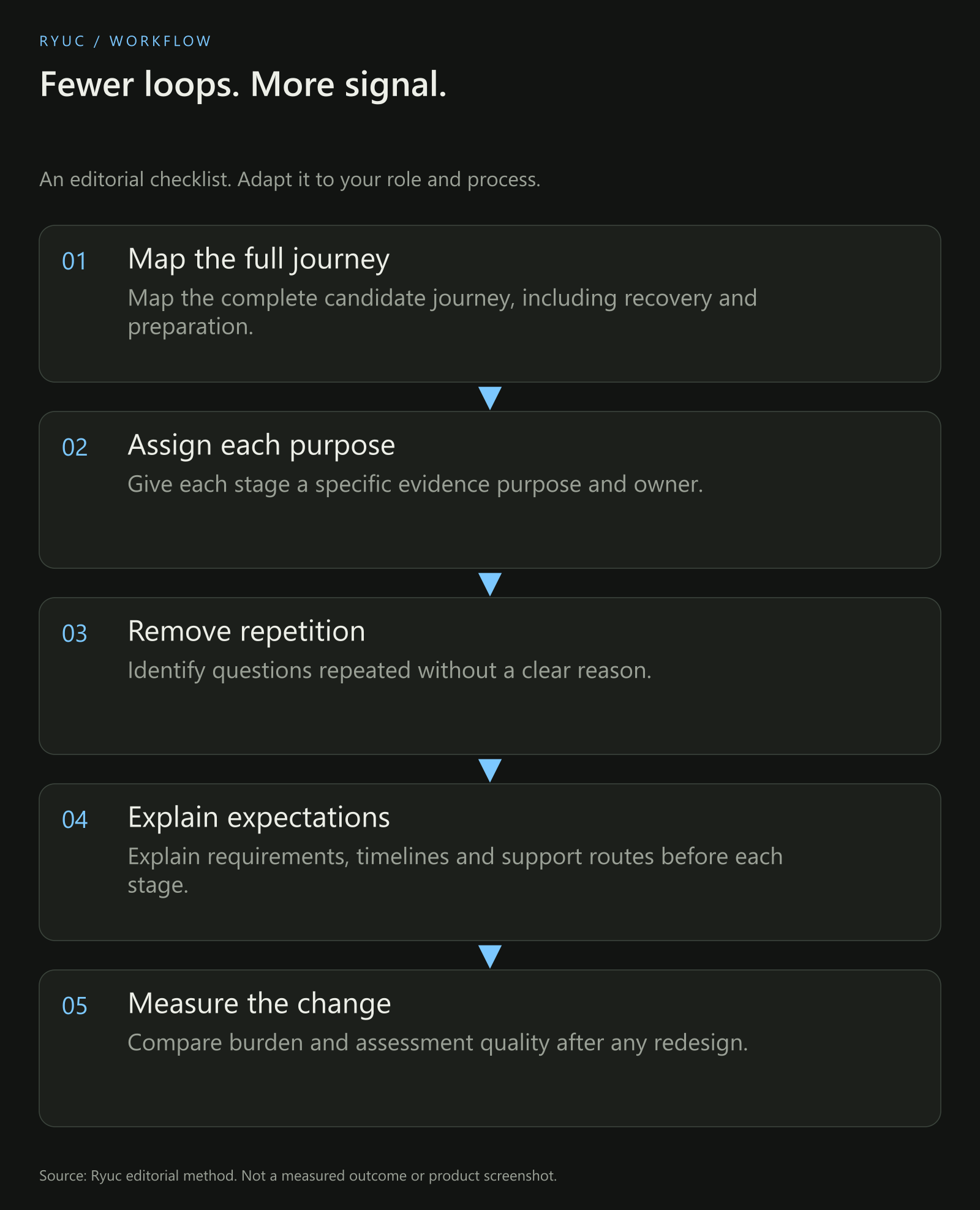
Our proposed audit process. It represents a design method, not measured candidate outcomes.
Create a simple record for each stage: purpose, expected candidate time, evidence collected, owner and reason for the next stage. Ask recent participants which parts were unclear or repetitive, without requiring them to share sensitive personal information.
Also count interviewer commitments across roles. A shortened candidate loop can still overload a small group of interviewers if they attend every stage for every vacancy.
What does the arithmetic look like?
Suppose an illustrative process asks for a 20-minute automated interview, a 30-minute recruiter call, a 60-minute technical exercise and a 45-minute final conversation. The scheduled assessment time is 155 minutes before preparation, forms or waiting.
Adding another 20-minute AI stage brings that example to 175 minutes. Replacing the 30-minute recruiter call with the 20-minute stage would instead make it 145 minutes. These are different process changes, even if the same tool is involved.
This is our arithmetic using invented planning inputs. It does not establish typical interview lengths or prove that replacement is appropriate. The point is to evaluate the whole loop and the evidence a stage contributes.
Which changes are worth trying first?
Give each competency an owner. If technical reasoning is assessed in one exercise, the next interviewer can probe the unresolved issue rather than repeat the whole exercise.
Make instructions consistent. Tell candidates what is required, how long it should take, what assistance is allowed and what to do if the session fails. Do not make a reset or accommodation request feel like an unexplained exception.
Share reviewed summaries with interviewers while preserving access to original evidence. A good scorecard helps the next person understand what has already been assessed and what remains uncertain.
Can fewer interviews create a weaker decision?
Yes, if a stage with a genuine purpose is removed without replacing its evidence. The goal is proportionality, not the fewest possible conversations.
OPM's structured-interview guidance supports designing questions around job-related competencies and consistent standards. That gives you a useful test: if you remove a stage, where will its required evidence come from? Source: OPM.
Keep a necessary work sample when it measures something a conversation cannot. Remove duplicated introductions and generic questions when they do not resolve a new uncertainty.
What should candidates do when the process feels excessive?
Ask the recruiter for the remaining stages, expected time and the purpose of the next assessment. Explain practical constraints without assuming the recruiter controls every part of the process.
You can also ask whether an earlier work sample or interview can inform the next stage. The answer may be no, but the request makes the burden visible and gives the employer a chance to explain.
For wording, use our questions to ask at the end of an interview. Choose a question about the process that matters to your decision rather than presenting a long interrogation.
What should you measure after a change?
Track completion, withdrawals by stage, elapsed time, repeated questions and candidate feedback. Measure the evidence quality and later reviewer corrections too. A stage becoming shorter does not prove that the assessment improved.
Look at cases where people drop out rather than relying only on feedback from successful finalists. Participation and response bias can make a process look more comfortable than it was for everyone who encountered it.
Our agentic hiring workflow shows how explicit handoffs can reduce avoidable repetition without removing responsibility for the decision.
Your next steps
- Map the complete candidate journey, including recovery and preparation.
- Give each stage a specific evidence purpose and owner.
- Identify questions repeated without a clear reason.
- Explain requirements, timelines and support routes before each stage.
- Compare burden and assessment quality after any redesign.
Download the interview-fatigue audit checklist.
Frequently asked questions
Does AI automatically reduce interview fatigue?
No. It can remove coordination work or provide a convenient assessment format, but it can also add another requirement. Evaluate what the tool replaces, what evidence it adds and what effort it creates for candidates.
How many rounds are too many?
There is no universal cutoff. A useful question is whether every round gathers necessary, distinct evidence proportionate to the role. Explain the expected sequence and review stages that repeatedly cover the same ground.
Should candidates withdraw from long processes?
That is a personal decision based on interest, constraints and the information available. Ask about the remaining commitment and what the next stages assess. A clear explanation may help you decide whether the opportunity is worth continuing.
Sources
- OPM: Structured Interviews
- The workload example and audit checklist are original editorial tools, not survey data.