An AI interview is a conversation or assessment in which software helps ask questions, capture responses or evaluate evidence. That description covers very different products. A tool that records a human interview is not doing the same job as a voice agent that conducts the first round.
Short answer: Start with the hiring decision you need to support, then decide which interview tasks software can handle. Keep the assessment tied to the job, explain the process to candidates and give a named person responsibility for reviewing the evidence.
What we verified: We reviewed official structured-interview and work-sample guidance. The workflow and examples below are our editorial recommendations. We have not demonstrated that an AI interviewer predicts employee performance or improves outcomes for your organization.
What does an AI interview actually do?
Separate four functions before buying or building anything. An assistant may schedule an interview. A notetaker may transcribe a conversation. An interviewing system may ask questions and select follow-ups. An assessment system may assign scores or recommend a next step. Vendors sometimes package all four under one label.
Ask which function changes a candidate's opportunity. A transcription error is inconvenient when it affects meeting notes; it becomes more consequential when it changes a score used to exclude someone. Your review process should reflect that difference.
Also distinguish an employer's AI interviewer from a candidate's interview copilot. The former gathers assessment evidence; the latter may suggest answers. Our Parakeet AI assessment-integrity guide discusses that separate problem.
What makes the interview structured?
Structure starts with job-related competencies, comparable questions and a defined rating standard. The US Office of Personnel Management describes structured interviews as using predetermined questions and common scoring standards. That is a useful foundation even when your organization operates outside US federal hiring. It is assessment guidance, not a statement that one process satisfies every jurisdiction's requirements. Source: OPM.
An adaptive conversation needs additional care. If one candidate receives a helpful hint and another receives a harder problem, the final numbers may look comparable while the opportunities were different. Define which clarifying probes are permitted, record which were used and keep the scored competency unchanged.
For a customer-support role, a competency might be identifying an unresolved issue and choosing an appropriate escalation. A broad label such as confidence is much harder to interpret. A fluent answer can lack the evidence the role requires.
How should the first-round workflow work?
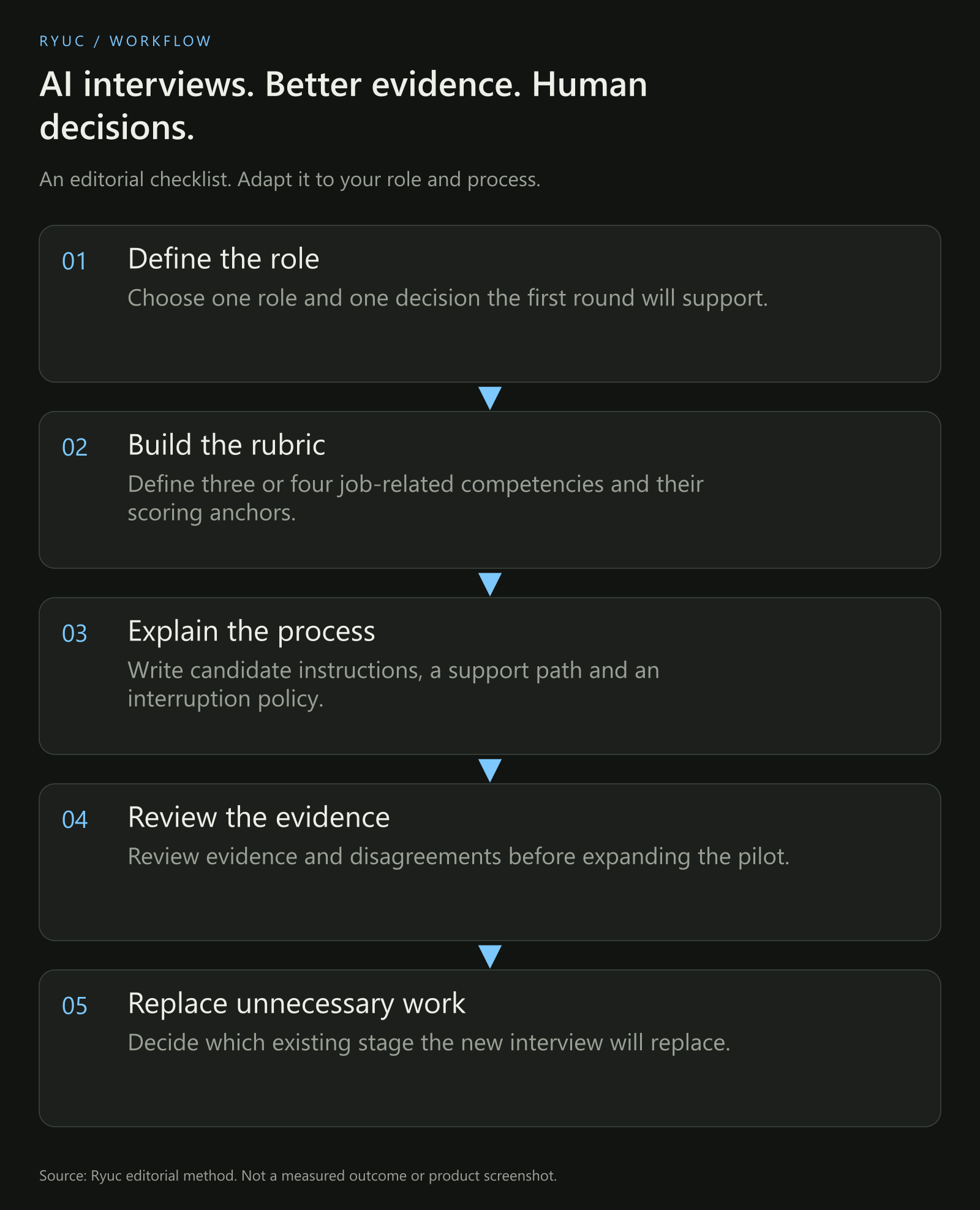
Our proposed workflow. The diagram describes a process, not a measured performance result.
- Agree on the role requirements and the evidence that would demonstrate them.
- Draft the questions and scoring anchors before seeing candidates.
- Tell candidates how AI is involved, what is recorded and how to request support or an alternative.
- Run the conversation and preserve answer-level evidence.
- Let a reviewer inspect uncertain scores, technical failures and relevant context.
- Record the decision and the reason for any override.
The useful output is an evidence package, not simply a number. A reviewer should be able to move from a rating to the relevant response and understand the rule that produced it. See our scorecard guide for a worked example.
What should you ask candidates?
Ask questions that resemble the reasoning required at work. For a support role, describe a customer reporting a duplicate charge and ask what the candidate would verify before proposing a remedy. For a junior engineer, ask them to explain a small change to an existing project rather than recite a definition unrelated to the role.
Follow-ups should establish ownership and reasoning: What did you personally do? Which constraint changed your decision? What would you check next? These questions can clarify evidence without pretending that a particular speaking style proves competence or honesty.
Keep the interview proportional to its purpose. If the first round establishes minimum role fit, do not quietly turn it into a long unpaid project. A later work sample may be appropriate, but it should have its own purpose, instructions and review standard.
How do you protect candidate experience?
Make the practical details visible before the interview: expected duration, voice or text requirements, recording, allowed tools, deadlines and a contact for problems. Provide a way to recover from a failed connection without treating the failure as a poor answer.
Do not require candidates to guess whether an assistive tool is allowed. Specify the rules and offer a private route to discuss accommodations. US EEOC material illustrates that using AI does not erase existing discrimination protections or potential accommodation obligations; organizations must check the rules applicable to their own hiring. Source: EEOC.
Avoid adding an automated conversation on top of every existing interview. If it replaces no work and produces no new evidence, it may simply increase AI interview fatigue.
How should you evaluate a pilot?
Create a small evaluation set with permission to use its data. Include incomplete answers, ambiguous responses, relevant experience described in different ways and technical interruptions. Have trained reviewers score the same material independently before comparing them with the system.
Track disagreement by competency and investigate causes. Was the rubric vague? Did the transcript miss a qualification? Did the model infer experience the candidate never stated? Different causes require different fixes.
Measure reviewer time and candidate burden alongside system performance. Define your success criteria before the pilot. A faster process that causes more corrections or loses useful applicants has not necessarily improved hiring.
Use a job-relevant work sample when direct demonstration is needed. OPM notes that work samples should reflect work candidates are expected to be able to perform on entry; testing a skill intended to be taught after joining can be inappropriate. Source: OPM work samples.
What should stay with people?
People should own the role definition, assessment criteria, exceptions and consequential decisions. They should also own complaints and corrections. A button labelled approve provides little oversight if the reviewer cannot see the evidence or is expected to accept every recommendation.
Choose a review boundary that your team can actually operate. Define when an interviewer should stop, when an uncertain response needs another assessment and who can change a score. Our agentic hiring guide expands that boundary beyond the interview itself.
Ryuc's AI interview product page describes its employer-facing workflow. Evaluate any product against your rubric and real operational needs rather than assuming its category label establishes suitability.
Your next steps
- Choose one role and one decision the first round will support.
- Define three or four job-related competencies and their scoring anchors.
- Write candidate instructions, a support path and an interruption policy.
- Review evidence and disagreements before expanding the pilot.
- Decide which existing stage the new interview will replace.
Download the AI interview planning checklist.
Frequently asked questions
Is an AI interview the same as a video interview?
No. A video interview describes the medium. AI may assist a live human interview, analyze a recording or conduct an interactive conversation. Ask who selects questions, how responses are assessed and whether a person reviews the result.
Can an AI interview make hiring unbiased?
That is not a defensible blanket promise. Outcomes depend on job criteria, data, implementation and human decisions. Evaluate the process on your population and investigate errors. Consistent formatting alone does not establish fairness or job relevance.
Should an AI interview replace the final hiring conversation?
The appropriate role depends on what evidence is missing. A first-round system can support screening, but a hiring team still needs a process for assessing the job, answering candidate questions and owning the decision. Do not remove a stage merely because software can imitate its format.