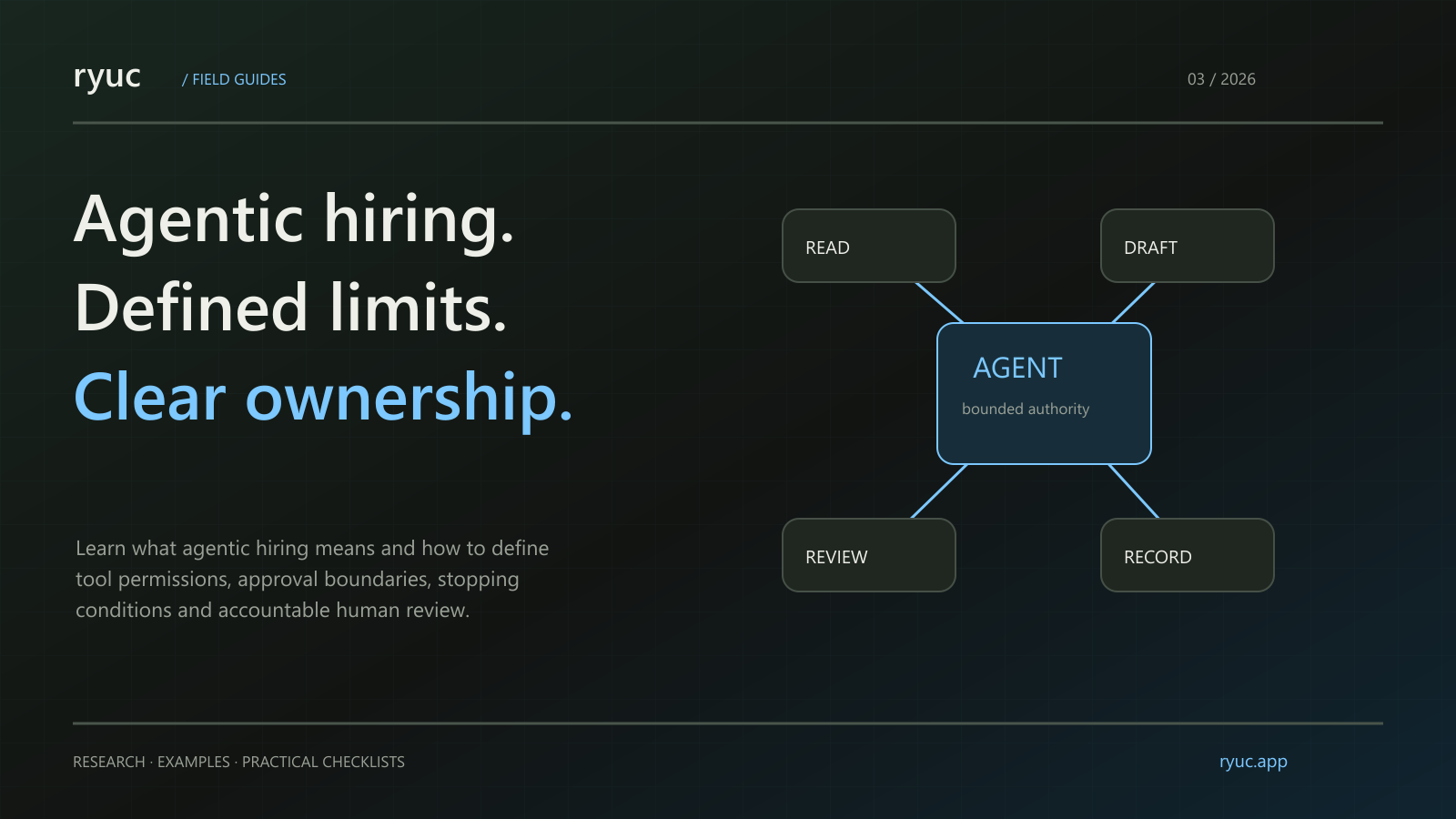
Agentic hiring describes recruiting systems that can pursue a task through multiple steps and tools. That might mean identifying missing information, preparing an interview plan and proposing a next action. The useful question is how much authority the system has over each step.
Short answer: Automate bounded work with observable results. Give an agent the minimum permissions it needs, define stopping conditions and keep decisions affecting a candidate's opportunity under accountable human review.
What we verified: We reviewed primary guidance on agent design and AI risk management. The hiring controls below are our proposed operating model. They are not a claim that an agent has been deployed successfully at your organization.
What makes hiring automation agentic?
A fixed workflow follows predefined steps. An agent can choose some of its next steps based on the task and feedback from tools. Anthropic uses this distinction in its foundational explanation of agentic systems. That terminology is helpful, but it is not a certification or a universal definition of a recruiting product. Source: Anthropic.
For example, a form that always sends an email after submission is ordinary automation. A system that notices a missing requirement, consults an approved source and drafts a clarification request is doing more dynamic work. Neither is inherently better; the second creates additional behavior to evaluate and control.
Our AI interview guide covers one specific component of this broader workflow.
Which hiring tasks are sensible starting points?
Start with tasks whose inputs, outputs and errors are easy to inspect. Drafting a role summary from an approved brief is a better initial pilot than allowing an agent to decide which applicants deserve an opportunity.
Other candidates include checking whether required application fields are present, preparing interviewer packets, proposing calendar options and drafting a client report from reviewed evidence. Each still needs appropriate access, review and correction paths.
Do not let an agent resolve an ambiguous requirement by inventing a preference. “Strong communication” is not permission to filter applicants by accent or speaking style. An unclear rule should produce a question for the role owner.
Where should the agent's authority stop?
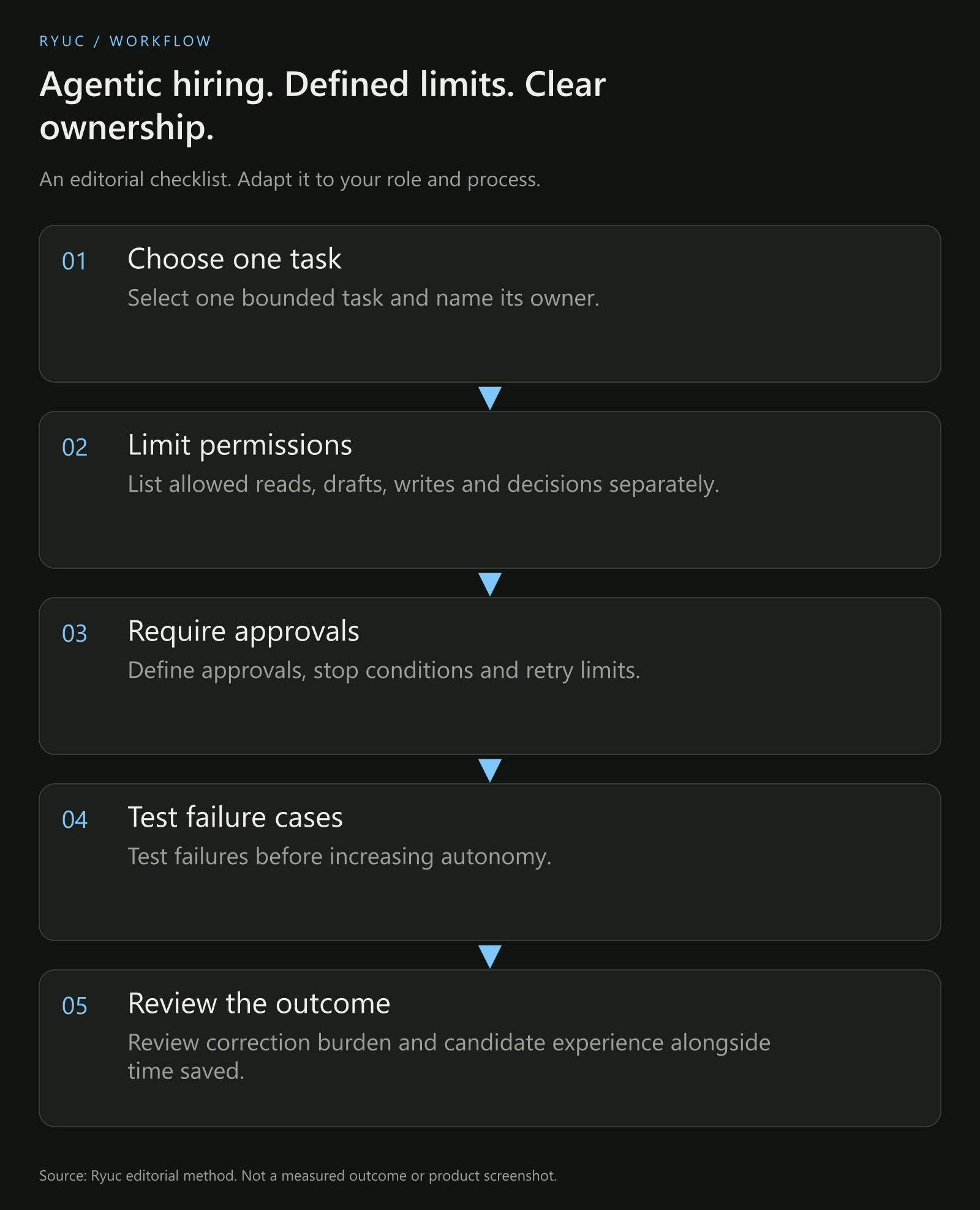
Our proposed control model. This is process guidance rather than an empirical assessment of a product.
Write an authority policy in terms of actions. Reading a role brief, drafting a message and sending that message are different permissions. Suggesting a shortlist and rejecting an applicant are also different actions.
| Action | Suggested initial boundary |
|---|---|
| Summarize an approved job brief | Allow, with source references |
| Draft candidate communication | Allow drafting; review before sending |
| Propose interview availability | Allow within explicit calendar constraints |
| Change assessment criteria | Require role-owner approval |
| Advance, reject or make an offer | Require an accountable human decision |
These are starting recommendations. Your organization needs to decide its actual policy and check applicable rules. A vendor's tool capability should not silently become your permission model.
Why is a human approval button insufficient?
A reviewer needs the evidence, the proposed action, the reason for it and the ability to decline. Approval becomes superficial when the reviewer sees only a polished summary or faces a queue too large to examine.
Show what changed since the last approval. If the candidate supplied new information or the role owner changed a requirement, an earlier approval may no longer apply. Bind approval to the actual version of the action being taken.
Record overrides and corrections without treating every disagreement as a reviewer failure. Disagreement can reveal a vague rubric, a poor source or an inappropriate task for automation.
How do you prevent actions from repeating?
Define an identifier for each intended action. If a scheduling request times out, the system should check whether it succeeded before sending another invitation. Otherwise, retry behavior can produce duplicate messages or conflicting appointments.
Keep the operation's state explicit: proposed, approved, attempted, confirmed or failed. A tool response saying accepted may not mean the person received the message or the calendar event was created as expected.
Set limits on retries, elapsed time and cost. When the agent reaches a limit, it should pause with a useful explanation and hand the task to a person. Repeatedly trying the same action is not useful autonomy.
What data should an agent see?
Give it access based on the task. A scheduling assistant usually needs availability and the relevant participants, not every interview recording or a full applicant history.
Treat resumes, emails and documents as data, not as authority to change operating rules. An instruction embedded in a resume should not grant permission to export candidate information or modify the evaluation criteria.
Also separate customer or client workspaces. An agency should not rely on a model remembering which client's information it may reveal. Enforce that boundary in the tools and data access layer.
How do you evaluate agentic hiring?
Test the entire process, including failure cases. Useful examples include a withdrawn candidate, a revoked approval, unavailable calendar slots, a duplicate request, a misleading document and a tool that returns an incomplete result.
Measure useful completion, correction burden and unauthorized-action attempts. Do not report only the number of tasks the system touched. Record how often a human had to repair an action after approval.
NIST's AI Risk Management Framework offers voluntary guidance for considering AI risks across design, use and evaluation. It is a risk-management resource, not a product endorsement or a substitute for local hiring requirements. Source: NIST.
How should an agency introduce it?
Choose one narrow workflow, a responsible owner and a rollback path. Run in suggestion mode first, compare outputs with the existing process and review exceptions before expanding permissions.
Tell clients and candidates what the system does when it matters to their interaction. Avoid presenting an automated message as a personal human judgment. Keep contact details available for corrections or a different route through the process.
Our agentic hiring workflow turns these controls into a practical sequence. The scorecard guide explains the evidence that should reach the decision-maker.
Your next steps
- Select one bounded task and name its owner.
- List allowed reads, drafts, writes and decisions separately.
- Define approvals, stop conditions and retry limits.
- Test failures before increasing autonomy.
- Review correction burden and candidate experience alongside time saved.
Download the agent authority checklist.
Frequently asked questions
Does agentic hiring mean replacing recruiters?
It describes how a system performs work, not a required staffing decision. Useful deployments can assist recruiters with preparation and coordination while people retain assessment and relationship responsibilities. Evaluate the task and outcome rather than treating autonomy as the objective.
Can an agent change the hiring criteria when it finds better candidates?
That should be an explicit role-owner decision. Quietly changing criteria can make comparisons inconsistent and undermine the agreed brief. The agent can propose a revision, explain the evidence and wait for approval.
Is agentic hiring automatically compliant if a person approves?
No blanket conclusion follows from an approval step. Compliance depends on the jurisdiction, assessment, data, actions and actual operating practices. Human review is a control to design and evaluate, not a universal exemption.