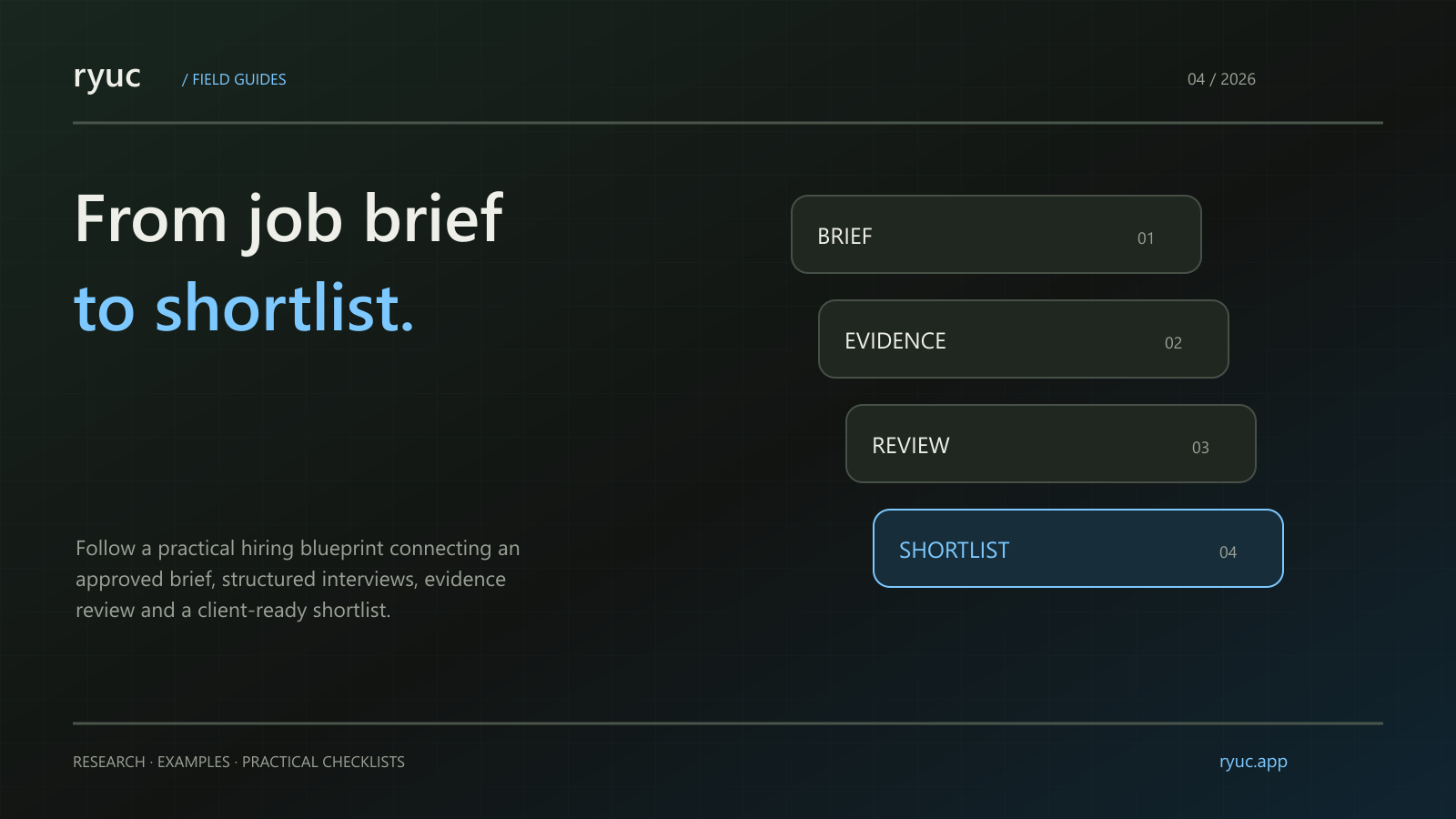
A hiring workflow starts to break when each handoff changes the meaning of the role. The client asks for one skill, the recruiter searches for a different keyword and the interviewer scores a third interpretation. Automating those handoffs can move the inconsistency faster.
Short answer: Use one approved job brief, one versioned rubric and traceable evidence from application to shortlist. An agent can organize work and propose actions, while people own changes to requirements and candidate decisions.
What we verified: The sequence below is an original implementation blueprint informed by structured-assessment and agent-design guidance. It is not a report of a live customer deployment or a measured reduction in recruiting time.
Step 1: Turn the job brief into an assessment plan
Ask the hiring manager what the person must accomplish, what they must know on entry and what they can learn after joining. Separate genuine requirements from preferences.
For an illustrative junior support role, the outcomes might be investigating a billing issue, explaining the next step and recognizing when approval is needed. The plan should say how each outcome will be assessed, not simply list keywords to search in resumes.
An agent can draft this plan from an approved brief. The role owner should resolve ambiguities and approve the version used for the hiring batch. See our agentic hiring overview for the authority boundary.
Step 2: Decide what the application should establish
Collect only what is useful for the stage. If availability is the only scheduling constraint, a long questionnaire about the candidate's entire work history may add little value.
Distinguish application completeness from qualification. A missing attachment may need a request for information; it is not automatically proof that the person lacks a skill. Decide which gaps can be clarified and apply that policy consistently.
Keep the application and the agent's interpretation separate. A summary can make review faster, but reviewers need a way to check the original material when the summary is uncertain or disputed.
Step 3: Prepare a consistent first-round interview
Map each approved competency to a question and rating standard. Define the neutral clarifications an interviewer may use. Record the actual questions asked.
OPM's structured-interview guidance emphasizes comparable questions and common rating standards. An adaptive interface still needs to preserve the substance of that comparability; a conversational style does not remove the assessment design problem. Source: OPM.
Explain the process, expected time, permitted tools and support route before asking the candidate to begin. Our AI interview guide covers those candidate-facing details.
Step 4: Capture evidence before making recommendations
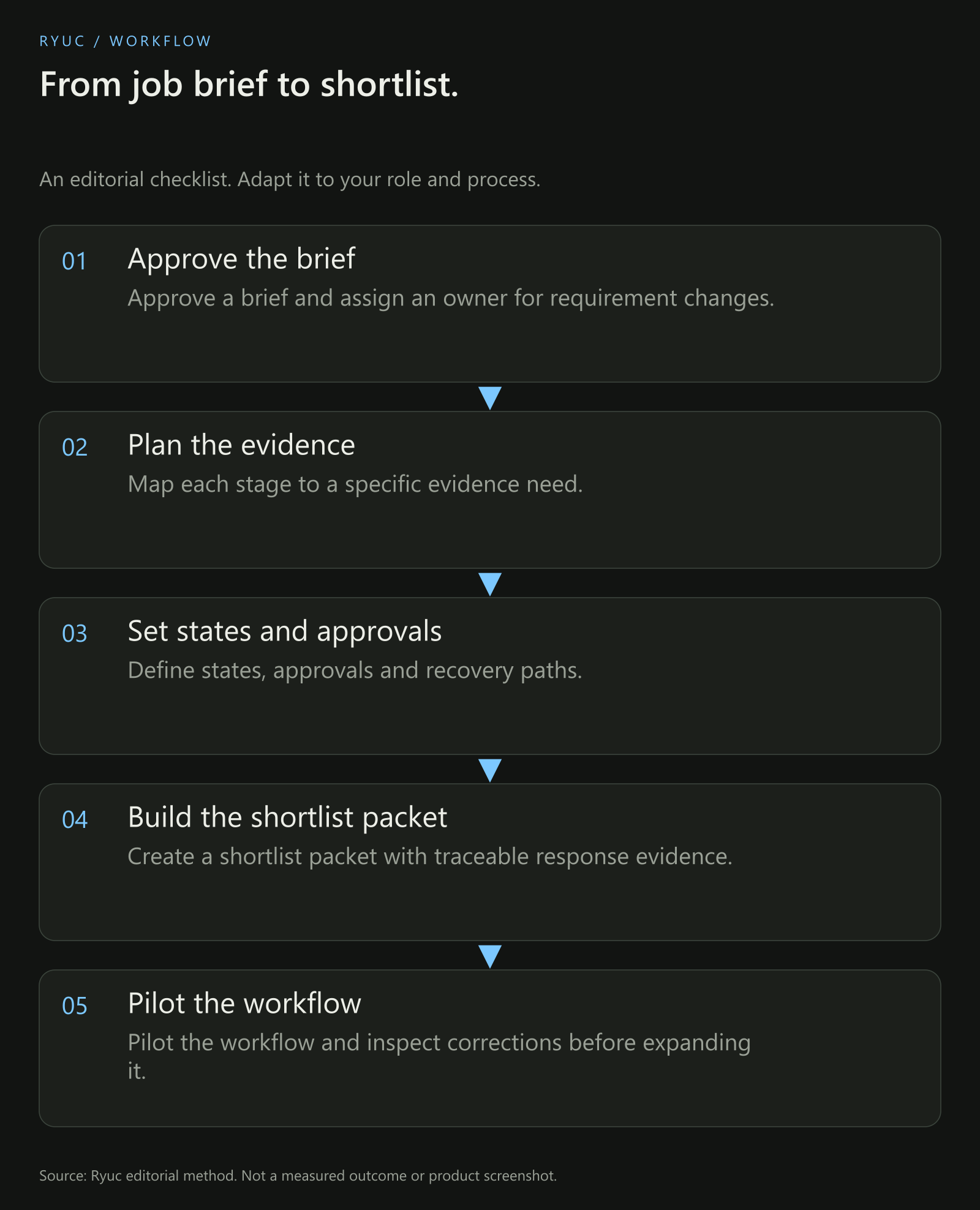
Original workflow blueprint. It does not represent measured results or an automated rejection system.
Produce a record containing the criterion, relevant answer, proposed anchor and unresolved uncertainty. Avoid replacing this evidence with an unsupported description of the candidate's personality.
If the assessment requires a task demonstration, select a work sample that reflects a skill needed on entry. OPM notes that a work sample may be inappropriate when the relevant work activity will be taught after selection. Source: OPM work samples.
The scorecard design guide includes a sample rubric. Its example is a starting point for discussion, not a ready-made pass threshold.
Step 5: Review exceptions and decide the next action
Assign a reviewer to ambiguous cases, capture problems and proposed exclusions. Give that person access to the underlying evidence and a clear policy for requesting another assessment.
An interruption should have a recovery route. A candidate who loses connectivity should not need to guess whether restarting creates a duplicate attempt or invalidates their application. Record what happened and how the case was resolved.
When a person overrides a recommendation, retain both the original suggestion and the reason for the change. This creates a useful correction record for the process owner without rewriting history.
Step 6: Build a shortlist packet the client can inspect
For each shortlisted candidate, include the role requirements addressed, relevant evidence, unresolved questions and the recruiter's recommendation. Explain why the next conversation is needed.
Keep the client decision distinct from the recruiter's recommendation. An agency's report should not imply that a client has approved a candidate when the client has not yet reviewed the evidence.
Avoid a ranking that suggests more certainty than the assessment supports. If two candidates have different strengths or incomplete evidence, show that difference instead of forcing a precise total order.
Step 7: Coordinate the next stage without repeating it
Carry forward what the candidate has already demonstrated. Give the next interviewer an explicit objective so they do not repeat the same background questions without a reason.
An agent can propose scheduling options and prepare a briefing note. Require approval before sending messages until the system's permissions and failure behavior are well understood. Check whether a timed-out operation succeeded before retrying it.
The purpose of coordination is to reduce unnecessary work, not to fill the calendar with more interviews. Read our interview-fatigue guide for a practical way to examine repeated stages.
How should you test the workflow before launch?
Use fictional or appropriately authorized data. Include a complete application, a missing field, a withdrawn candidate, a changed requirement, a duplicate request and an interview interrupted halfway through.
For each case, record the expected state and who may move it forward. The system should not send an invitation after withdrawal, apply an old approval to changed content or silently reinterpret a failed tool call as success.
Review this proposed hiring workflow as an operations checklist.

For every step, identify the input, expected output, allowed tools, responsible person and stopping condition. Flag missing approval boundaries, duplicate-action risks and places where evidence is replaced by inference. Do not rank or reject candidates.
This is a review prompt, not an automated compliance assessment. A process owner must decide the controls and verify that the implementation follows them.
What should you measure?
Track time between stages, candidate completion, repeated questions, reviewer corrections and failed or duplicate actions. Define the measures before the pilot and report their denominators.
For example, a shorter average processing time can hide a growing group of unresolved cases. Review distributions and exceptions, not just a headline average. A decrease in recruiter work also needs to be considered alongside any extra effort imposed on candidates or clients.
Your next steps
- Approve a brief and assign an owner for requirement changes.
- Map each stage to a specific evidence need.
- Define states, approvals and recovery paths.
- Create a shortlist packet with traceable response evidence.
- Pilot the workflow and inspect corrections before expanding it.
Download the hiring-workflow checklist.
Frequently asked questions
Do we need an agent for every stage?
No. A fixed rule or a simple checklist may be easier to understand and maintain. Use dynamic agent behavior only where choosing the next step adds demonstrable value and can be evaluated. More components create more handoffs to inspect.
Should every applicant complete the same assessments?
Candidates being compared need a consistent, job-relevant process, with appropriate accommodations and clearly managed exceptions. That does not mean every role uses an identical assessment. Define the purpose and criteria for each hiring process.
Can this workflow guarantee a stronger shortlist?
No workflow diagram establishes that result. The blueprint helps organize evidence and responsibility. Your team must evaluate whether its actual implementation produces useful, accurate assessments and a reasonable experience for candidates.