If you are asking how to stop Parakeet AI cheating in interviews, begin with the assessment rather than a promise of perfect detection. A remote interview gives you a limited view of the candidate's environment. The practical objective is to obtain credible evidence under clear rules and review concerns fairly.
Short answer: Explain which assistance is permitted, use role-relevant tasks and follow-ups, and require candidates to demonstrate their reasoning. Parakeet also publishes an employer blocklist request route. Treat it as one possible control, not proof that all assistance has been prevented.
What we verified: We read Parakeet's public website and its employer blocklist statement on 27 October 2026. We did not install the product, test its invisibility claims or measure a detector's performance. The assessment controls below are our recommendations.
What is Parakeet AI?
Parakeet is a candidate-side assistant whose website advertises suggestions during conversations, coding help and interview preparation. Its marketing also claims concealment from other participants. Those are vendor descriptions, not independent findings from our testing. Source: Parakeet.
That is a different product category from an employer's AI interviewer. A tool suggesting an answer does not establish that a candidate understands it. Equally, the presence of an assistant is not automatically a policy violation if an employer explicitly permits that use.
When does AI assistance become cheating?
Use the rules of the assessment to define the boundary. Practicing before an interview, using an approved accessibility tool and secretly outsourcing a restricted assessment are different situations.
Tell candidates whether they may use notes, documentation, search, generative AI or another person. Explain whether the rule differs between preparation, a live discussion and a take-home task. Provide a way to ask about accommodations without requiring a public disclosure during the interview.
The rules should match the skill you want to assess. If a role routinely involves reviewing AI-generated code, a disclosed AI-assisted exercise may be more appropriate than an unsupported claim that all tool use can be detected.
What can an employer request from Parakeet?
Parakeet's public page says it accepts employer blocklist requests through compliance@parakeet-ai.com, using the employer's domain or hiring process. The page also tells users to respect restrictions imposed by employers or other assessment owners. Source: official Parakeet FAQ.
Ask the vendor to explain scope, verification, activation and limitations. Keep a record of what it confirms. We have not submitted such a request or tested enforcement, and a restriction in one product would not establish that other assistance is absent.
Do not send real candidate records merely to ask how the control works. Start with the organization and process information the vendor says it needs, and review any additional data request through your own procedures.
Why are polished answers weak evidence of cheating?
A fluent answer can come from preparation, relevant experience, rehearsal or help. A pause can reflect thought, connectivity or a range of other circumstances. Neither observation tells you which explanation is correct.
Avoid using gaze, accent, nervousness or a tab-switch event as a verdict. If an observation matters, document exactly what happened and offer a proportionate way to clarify the evidence. Do not replace that process with a label such as suspicious candidate.
This is particularly important when technology or communication differences affect the interview. US EEOC guidance is one authoritative reminder that AI-related assessment still operates within employment discrimination and accommodation requirements. Check the requirements relevant to your own jurisdiction. Source: EEOC.
How do you design a more credible assessment?
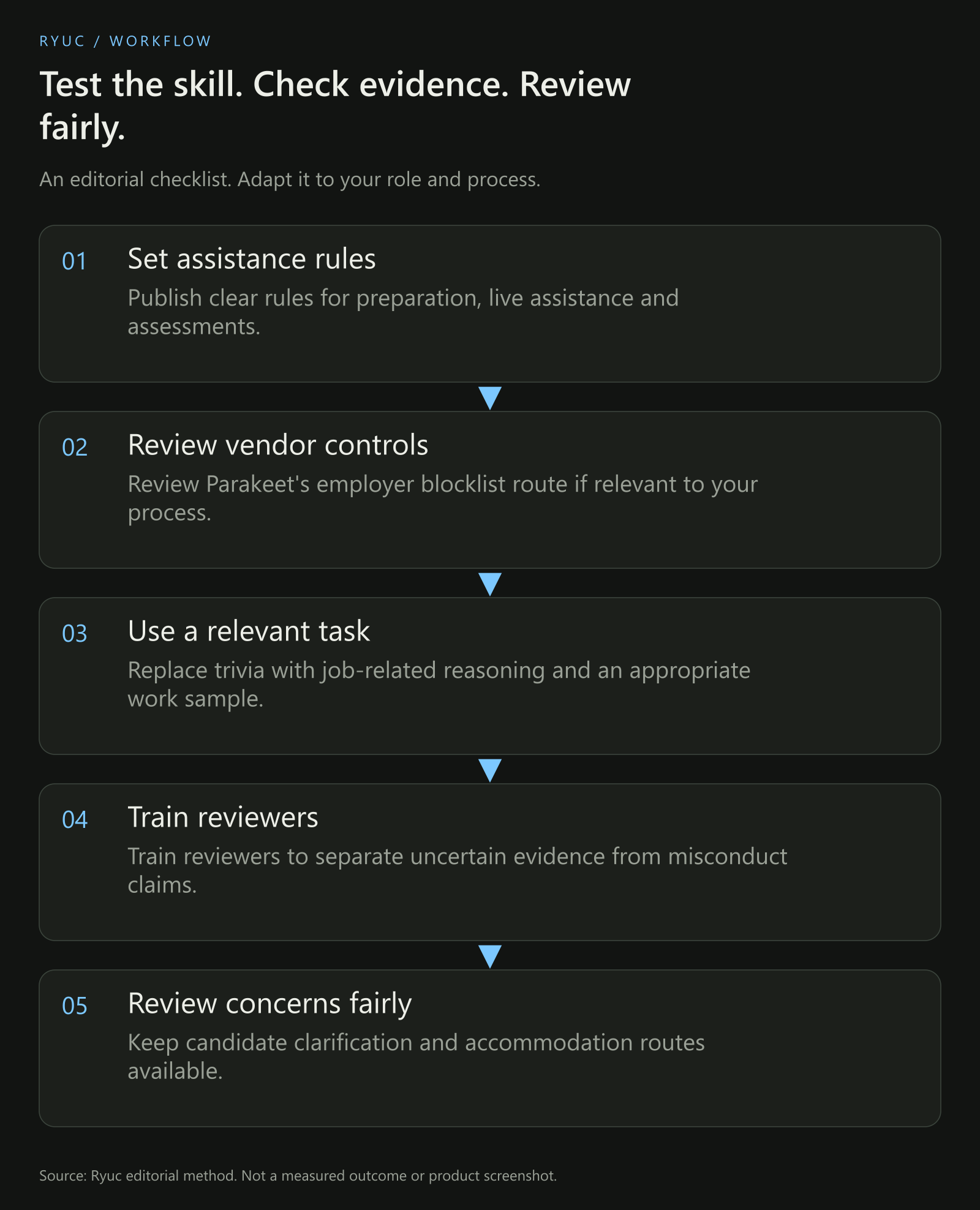
Our recommended assessment process. It is not a detection-accuracy claim.
Use a task connected to the work and ask the candidate to explain decisions. For a junior developer, that might mean reading a small existing function, identifying a failing case and explaining the change they would make. For support work, it might mean handling an ambiguous customer request with a defined policy.
Then introduce a job-relevant variation. What changes if the input is missing? Why choose this escalation? Which assumption would you test first? Keep the variation comparable across candidates and avoid turning the interview into an arbitrary trick.
OPM describes work samples as tasks resembling the job and cautions that they should assess competencies expected on entry. That supports careful task selection, not a blanket recommendation to add a difficult unpaid assignment. Source: OPM work samples.
What does a fair follow-up sound like?
Suppose a candidate gives an answer that is technically correct but cannot yet be evaluated. Ask them to explain one decision, work through a small example or identify a limitation. Score the demonstrated reasoning using the same criterion you would use for anyone else.
For example: “You suggested retrying the request. How would you avoid creating a duplicate payment if the first attempt succeeded but timed out?” This checks understanding of the proposed solution. It does not require accusing the candidate of using a particular product.
If the answer remains unclear, record insufficient evidence and apply the agreed next step. Our scorecard guide explains why that state should be separate from a misconduct finding.
Should employers ever allow AI in interviews?
Sometimes the relevant skill is using and reviewing AI assistance. Canva described a technical interview format in 2025 that explicitly expected AI use and assessed reasoning, code understanding and correction. That is a specific employer example, not permission for every candidate to use any tool in any interview. Source: Canva Engineering.
If you adopt an assisted format, explain it beforehand and make access requirements fair. Evaluate the candidate's ownership of the result: can they identify an incorrect suggestion, test an assumption and explain the tradeoff?
Keep a restricted assessment restricted when there is a legitimate reason, but give candidates a clear explanation of the permitted environment and the support route.
What should you do when a concern remains?
Preserve relevant evidence, distinguish observation from inference and involve the responsible reviewer. Give the candidate a reasonable opportunity to clarify under your established process. A repeat or alternative assessment should have a defined purpose, rather than becoming an escalating series of tests.
Do not claim that a browser event proves which application was running elsewhere. Do not promise that an AI interviewer is cheating-proof. The defensible outcome may be that you have insufficient evidence to assess a competency, rather than evidence of misconduct.
For the product's broader positioning and adoption claims, read our Parakeet usage guide.
Your next steps
- Publish clear rules for preparation, live assistance and assessments.
- Review Parakeet's employer blocklist route if relevant to your process.
- Replace trivia with job-related reasoning and an appropriate work sample.
- Train reviewers to separate uncertain evidence from misconduct claims.
- Keep candidate clarification and accommodation routes available.
Download the interview-integrity checklist.
Frequently asked questions
Can we reliably detect every Parakeet session?
We have no independently verified evidence establishing that. Vendor invisibility claims and vendor detection claims both require scrutiny. Design a process that obtains job-related evidence even when you cannot observe every tool in a candidate's environment.
Does a tab switch prove cheating?
No. It is an event with multiple possible explanations. Review its context and your stated assessment rules. Do not treat it as proof of a particular product, an intention or misconduct without supporting evidence and an appropriate review process.
Should we ban all AI preparation?
Preparation and restricted live assistance are different activities. A policy can permit learning and practice while defining limits during an assessment. Explain the boundary clearly and assess whether candidates can demonstrate the relevant skill themselves.