An HR-round conversation can cover motivation, communication, practical availability and expectations. It is useful preparation to explain those things clearly, but there is no universal script that guarantees a favorable decision.
Short answer: Use truthful, role-specific answers. Know your own application, explain practical constraints accurately and ask about anything important that remains unclear.
Method: These twenty questions are editorial practice examples, not a verified transcript from a particular employer. Sample answers are illustrative; adapt the reasoning to your actual circumstances rather than copying someone else's claims.
Motivation and background
1. Tell me about yourself.
Give a short account of your current work or studies, relevant evidence and reason for considering the role. Example: I have been working on customer-facing support and improving how I document recurring issues. I am now looking for a role where I can deepen that work and collaborate more closely with the product team.
2. Why do you want to join us?
Connect the role's actual responsibilities with your interests and evidence. Refer to something you checked in official materials or the interview. Avoid generic praise or claiming to know the internal culture from a slogan.
3. Why should we hire you?
Choose two or three relevant strengths with evidence. Example: I can contribute careful issue investigation and clear written handoffs. In my current work, I document the checks I performed so the next person can continue without repeating them. I would still need to learn your product and procedures.
4. Why are you considering a change?
Explain the forward-looking reason without inventing a story or attacking colleagues. Example: I have learned a great deal in my current role, and I am looking for work with more responsibility for process improvement. This opportunity appears to include that scope, which I would like to understand better.
5. Why did you choose this career path?
Describe a real experience that influenced the choice and what you have done to explore it. A student can discuss a project or course. An experienced applicant can explain how their interests developed through work rather than pretending the path was always obvious.
Strengths, feedback and responsibility
6. What is your greatest strength?
Pick a strength relevant to the work and demonstrate it. Example: I make uncertain work explicit. When a request is incomplete, I identify the missing decision and ask a focused question before committing the team to an assumption. That helps me produce a clearer handoff.
7. What is a weakness you are improving?
Choose a genuine development area and an action. Example: I sometimes spend too long polishing an explanation before sharing an early draft. I now agree on the purpose and send a rough outline sooner, so feedback arrives before I invest in the wrong detail.
8. Tell me about a mistake.
Take responsibility for a specific action and explain the correction. Avoid a story in which the mistake was actually someone else's fault. Our behavioral answer guide includes a fuller structure for describing a mistake without exaggerating the result.
9. How do you handle feedback?
Describe how you clarify the observation, act on it and check whether the change helped. Example: If feedback is broad, I ask for a concrete instance. I then make one change and request a follow-up review. I may discuss a disagreement, but I try to understand the evidence before defending the original choice.
10. How do you handle pressure?
Explain practical behaviors rather than claiming pressure never affects you. Example: I clarify the deadline and essential outcome, identify the next useful action and communicate risks early. If the full scope is unrealistic, I propose a smaller deliverable or ask which priority should move.
Teamwork and role fit
11. How do you resolve a conflict?
Focus on the work and the competing constraints. Explain how you listen, compare options and agree on a decision-maker when needed. A real example is stronger than simply saying you communicate well.
12. Do you prefer working independently or in a team?
You can explain the conditions rather than choosing an absolute. Example: I can complete a defined task independently, and I value review when a decision affects other people's work. I like clear ownership with a reliable way to ask questions and share progress.
13. What motivates you?
Use a truthful connection to the role. Learning, useful work, responsibility and compensation can all matter. Avoid inventing a passion for a task you do not enjoy simply because it appears in the description.
14. Where do you see yourself in a few years?
Discuss a direction and the skills you want to build, without promising an exact title. Example: I want to become someone who can own a broader problem from understanding the request through delivery and review. I am looking for work where I can build that judgment through real responsibility and feedback.
15. Why is there a gap or change in your resume?
Give the relevant truthful explanation at a level you are comfortable sharing, then explain your current readiness. Do not invent employment or a certification to fill the space. If a detail is private, you can keep the explanation appropriately concise.
Availability, expectations and process
16. What is your notice period or earliest start date?
Give the actual commitment and distinguish a confirmed date from an estimate. Example: My contractual notice is one month. I would need to confirm the release date with my current employer before agreeing to an earlier start. I can update you once that discussion is complete.
17. Are you willing to relocate or follow this working arrangement?
State your real position and ask about unresolved requirements. Do not agree to relocation, travel or working hours you already know are impractical. A clear conversation now is better than a commitment you cannot meet later.
18. What are your salary expectations?
Use current research relevant to the role, location and your experience if you are giving a range. If the scope is still unclear, you can ask for the budget first: I would like to understand the full role and package. Could you share the range budgeted for this position? This article does not supply a market salary estimate.
19. Do you have another offer?
Answer accurately and share only what you choose to disclose. Explain a genuine deadline if it affects the process. Do not fabricate an offer or invent urgency to pressure the recruiter.
20. Do you have any questions for us?
Ask about the work, expectations, support or remaining stages. Choose an unresolved point rather than reading a generic list. The end-of-interview questions guide includes options for HR and hiring managers.
How should you practice an HR round?
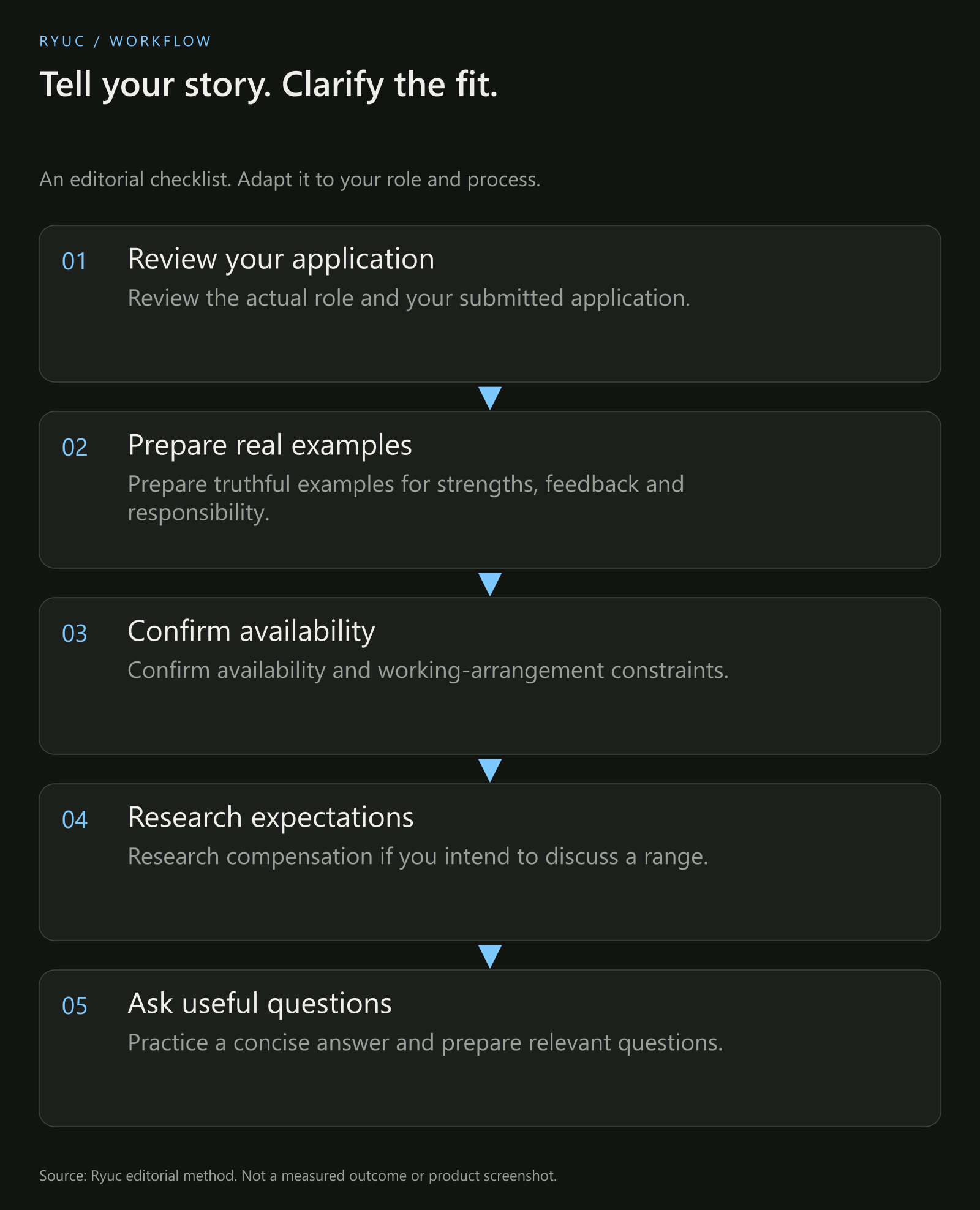
Original preparation process, not a claim that every employer follows the same HR format.
Read the application you submitted and check that your answers are consistent with it. Prepare relevant examples, your practical constraints and the questions you need answered. Practice aloud, but allow the wording to change naturally.
Official career guidance treats an interview as an opportunity for both sides to understand fit. That supports asking useful questions rather than treating the conversation only as a performance. Source: Harvard career services.
For students and first-time applicants, our internship guide and mock-interview plan provide additional preparation steps.
Your next steps
- Review the actual role and your submitted application.
- Prepare truthful examples for strengths, feedback and responsibility.
- Confirm availability and working-arrangement constraints.
- Research compensation if you intend to discuss a range.
- Practice a concise answer and prepare relevant questions.
Download the HR-round preparation checklist.
Frequently asked questions
Is the HR round only a formality?
Do not assume that. Its purpose varies by employer and stage. Prepare to explain your motivation, practical fit and relevant evidence, and use the conversation to clarify the opportunity.
Should I memorize these answers?
No. Use them to understand the structure and prepare your own facts. Memorized wording can become inaccurate or unhelpful when the interviewer asks a follow-up.
Can I decline to share private details?
You can keep your answer appropriately focused on job-relevant information and ask why a detail is needed. Requirements and protections vary by jurisdiction and situation; this article is general preparation, not a legal opinion.
Sources and method
- Harvard career services: Prepare for an Interview
- All sample answers are original fictional editorial examples.