
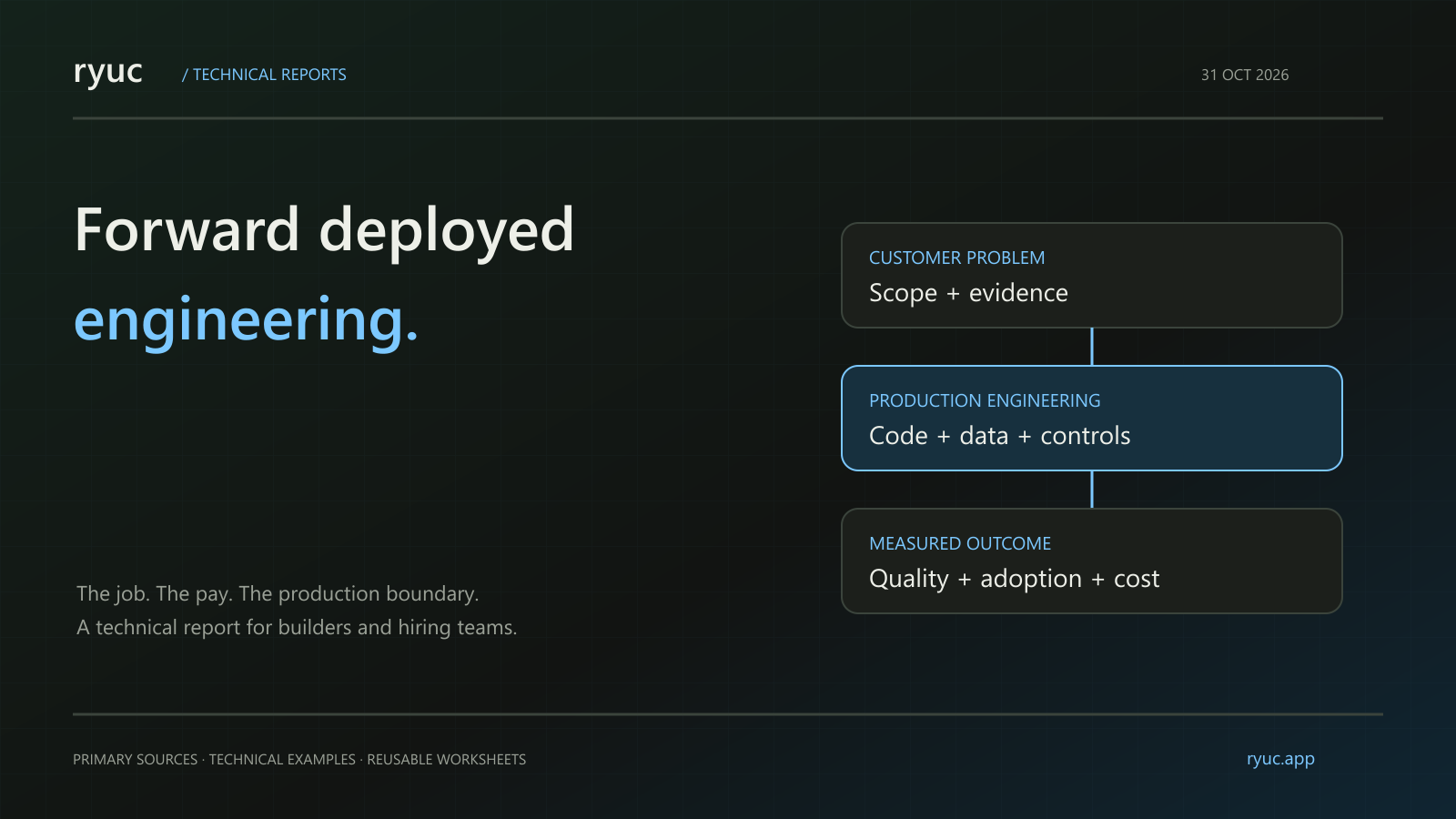
The forward deployed engineer is becoming more visible because buying access to an AI model is much easier than making that model useful inside a real business. A customer still needs working integrations, reliable data, access controls, an evaluation process and a person accountable for delivery. An FDE often owns the difficult work between a promising demonstration and a system people can use.
Short answer: forward deployed engineering combines substantial software engineering with customer discovery, delivery and product judgment. Some US employers advertise annual salary ranges above $185,000, but neither that figure nor a prominent startup offer establishes the market average. The work and compensation change considerably by employer, location and seniority. Opportunities also extend into AI evaluation, infrastructure, security, data and workflow operations.
Research scope, 31 October 2026: this report reads employer postings, company engineering material and original workforce research. Salary figures are advertised ranges, not accepted offers or an estimate of what every applicant will earn. The technical architecture, interview exercise and career plan below are original editorial proposals, not a customer case study. Growth forecasts are identified separately from observed evidence.
What is a forward deployed engineer?
An FDE is an engineer who works close to a customer to turn a product or platform into an operational solution. The customer may be external, or an internal business unit treated as a delivery partner. The engineer needs enough domain understanding to specify the right problem and enough technical depth to ship the solution.
The role predates the current generative AI boom. In an April 2019 explanation, Palantir distinguished its core platform engineers from engineers deploying and adapting those platforms around individual customers. Its description also included contributions back to the core product. It therefore makes little sense to describe FDE as a job invented by ChatGPT. AI has expanded the context in which the delivery model is useful. Source: Palantir's engineering-role explanation.
Today's AI-oriented version often combines five kinds of ownership:
- Problem definition: identify the user's task, constraints and baseline.
- Engineering: build data paths, APIs, interfaces and deployment infrastructure.
- Delivery: sequence work, resolve dependencies and handle production rollout.
- Measurement: establish quality, adoption, cost and operational reliability.
- Product feedback: turn repeated customer requirements into reusable capabilities.
OpenAI's San Francisco FDE posting explicitly covers discovery, technical scoping, system design, building and rollout. It ties success to production adoption, workflow impact and evaluation-driven product feedback. Juniper Square's Applied AI posting adds ongoing operation, retrieval, tool integration, evaluations, observability and cost controls. Those are concrete engineering responsibilities rather than a requirement to be good at demonstrations alone. Sources: OpenAI FDE, Juniper Square Applied AI.
The title is less informative than the job description
Read the required deliverables. A role called FDE might focus on implementation, advanced support, platform adoption, applied AI development or enterprise modernization. Ask whether you will own production code, configuration, architecture, customer relationships, commercial targets or some combination.
For example, Blitzy's Pune posting describes platform enablement while also listing Java, Spring Boot, PostgreSQL, REST APIs, Docker, testing and production observability. The same advertisement asks for more than ten years of engineering experience. It is a very different opportunity from an early-career deployment position. Source: Blitzy Pune posting.
How does FDE differ from nearby roles?
Think in terms of the main unit of responsibility. These boundaries vary by company; they are a reading framework, not a universal organization chart.
Product software engineer: usually develops a capability that serves many users or customers. An FDE may span several capabilities to solve one customer's operational problem, then work with product engineers to generalize the repeated parts.
Solutions architect or sales engineer: often concentrates on architecture, technical validation and purchase decisions. Some write significant code. An FDE role is more compelling for a builder when responsibility continues through deployment, adoption and operational handover. Pre-sales and post-sales responsibilities can overlap.
Implementation engineer or consultant: can perform much of the same work. The useful distinction is whether delivery produces maintained software, reusable platform improvements and accountable outcomes. A title change does not automatically make an implementation role more technical or better paid.
ML engineer or research engineer: may specialize in training, modeling, inference systems or research experiments. An FDE normally starts from the business workflow and chooses the model and surrounding system needed to support it. Some deployments need no custom training.
Customer success manager: usually owns account health and adoption through a different mix of responsibilities. An FDE's engineering accountability should be explicit even when they share adoption goals.
For candidates, the practical question is: What technical artifact and operational result will I own six months after joining?
What salary do forward deployed engineers earn?
The most defensible starting point is a dated set of employer disclosures. Do not average these examples together: they mix geography, experience requirements and company economics.
US salary disclosures checked for this report
Palantir, Forward Deployed Software Engineer, New Grad, Commercial, Chicago: the posting estimates $135,000 to $145,000 per year. It separately mentions potential restricted stock, sign-on bonus and other incentives. The role requests graduation in December 2026 or spring 2027 and describes travel of 25% to 50%, depending on team and location. This is an early-career example, not a compensation guide for senior frontier-model roles. Employer posting.
Juniper Square, Senior FDE, Applied AI, US remote: the disclosed US base range is $165,000 to $200,000, with equity and benefits separately described. The posting asks for at least five years shipping production software and hands-on AI application experience. Remote describes this US role; it does not promise the same pay or employment eligibility in India. Employer posting.
OpenAI, FDE, San Francisco: the disclosed base range is $185,000 to $300,000, with equity and eligible performance-related bonuses described separately. The posting asks for at least five years of engineering or technical deployment experience including customer-facing work, three office days a week and up to 50% travel. Employer posting.
OpenAI, Forward Deployed Software Engineer, San Francisco: the disclosed base range is $185,000 to $325,000 plus separately described compensation components. This related role asks for at least seven years of professional full-stack engineering experience, excluding internships. Its range should not be substituted for a new-graduate offer. Employer posting.
Across these selected US examples, advertised annual salary bounds span $135,000 to $325,000. That is the envelope of this small, deliberately selected set. It is not a representative US salary distribution, a median, or evidence that FDEs universally earn more than equally senior product engineers.
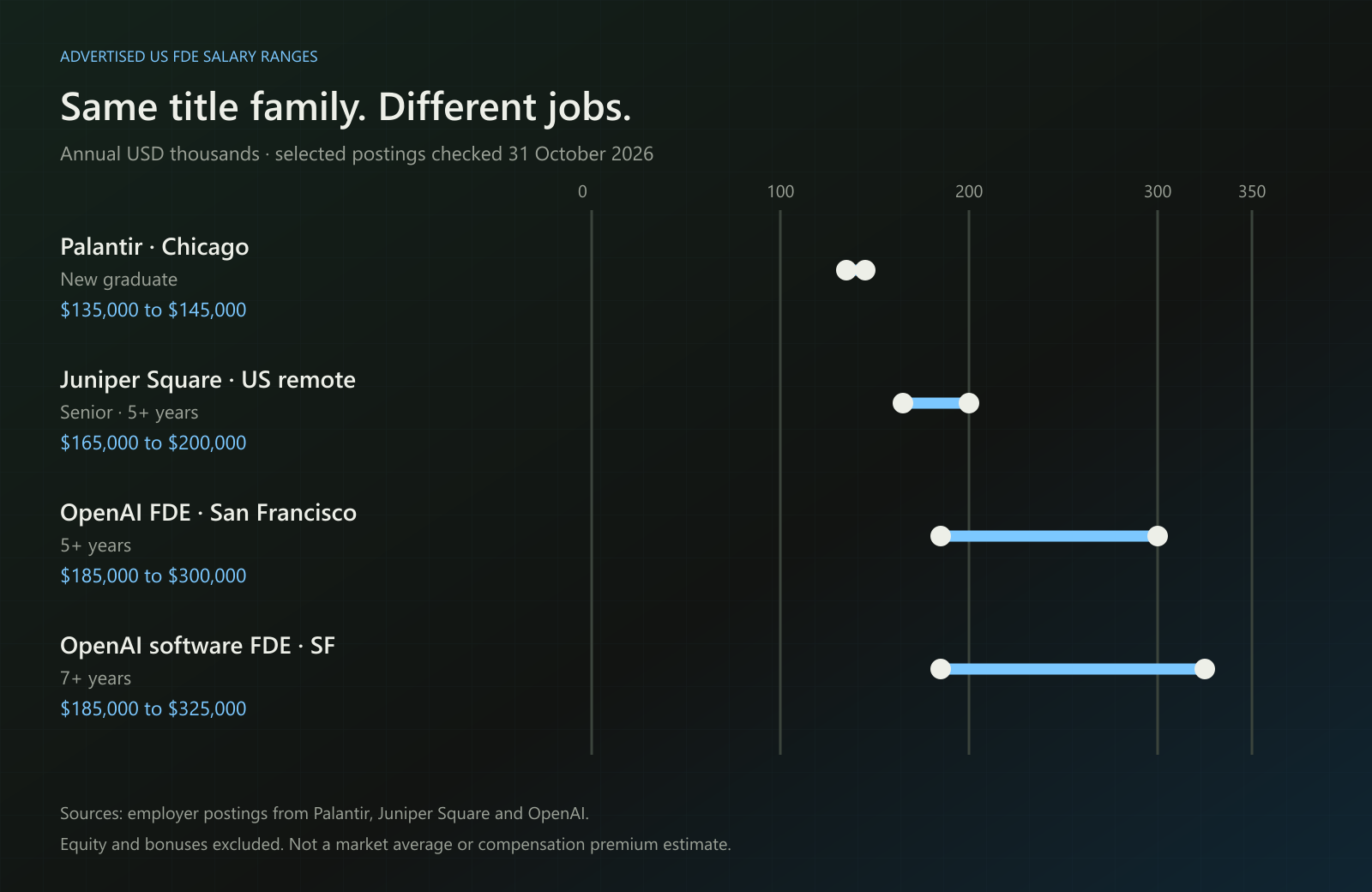
Employer disclosures checked on 31 October 2026. Annual USD salary ranges; equity and bonuses excluded from the plotted values. Selected examples, not a market survey.
India: what can actually be supported?
An employer-authored Aktoria Robotics listing on Y Combinator advertises ₹12 lakh to ₹20 lakh per annum for an on-site Noida FDE. Its header says new graduates are acceptable, while the description requests one to three years of engineering experience. That inconsistency is worth clarifying with the employer. The page does not clearly separate fixed salary from the complete CTC package. Employer-authored listing.
Blitzy's Pune advertisement confirms a substantially more experienced FDE opportunity but did not expose a numerical India pay band in the text reviewed. A salary negotiation should therefore begin by asking for that role's budget, level and pay structure rather than borrowing its US equivalent. Employer posting.
A widely circulated Cartesia Bengaluru advertisement appeared on Startup Jobs with a ₹70 lakh to ₹90 lakh annual range. The page reviewed for this report explicitly says the job is no longer available. We did not verify that range against a current employer posting, so it is excluded from the active salary comparison. It is an example of why a viral upper-end number cannot establish either a current opportunity or an India-wide norm. Archived third-party listing.
This research does not establish a reliable national FDE median for India. Sparse title-specific samples, mixed CTC definitions and different job families make a precise national number look more reliable than it is. For Indian applicants, compare offers at the same city, level, employer category and scope of ownership.
How to compare an offer properly
Separate recurring fixed cash, target variable cash, one-time cash and equity. Ask about vesting, cliff, liquidity, refresh grants, exercise costs where relevant, travel, on-call duties, working hours and review criteria. A four-year equity award is not annual salary, and target commission is not guaranteed cash.
An illustrative offer might contain ₹30 lakh fixed salary, ₹3 lakh target bonus and a ₹12 lakh quoted equity award vesting evenly over four years. The recurring cash would be ₹30 lakh fixed or ₹33 lakh at target. Simple annualization allocates ₹3 lakh of the quoted award per year, but does not make it spendable cash or guarantee its value. These numbers are fictional arithmetic, not a market benchmark.
Dollar-to-rupee conversion alone cannot resolve an offer comparison. Employment location, tax, living costs, equity risk, benefits and contractual obligations remain different.
Why is the role rising with AI adoption?
There is evidence of expansion, but measurement matters
LinkedIn's January 2026 labor-market report identifies FDEs as an emerging integration role and reports 42-fold growth since 2023. Treat that as LinkedIn's report-specific signal, not a verified count of open vacancies or a growth rate continuing through October 2026. Its data are shaped by platform coverage and role classification; title adoption and reclassification can contribute to apparent growth. The role's documented existence at Palantir in 2019 also shows why rhetoric about entirely new jobs needs care. Sources: LinkedIn report, page 10, Palantir 2019.
LinkedIn's separate January AI update reports 54% annual growth in Indian job postings requiring AI engineering skills during 2025. That is a broader skills category, not a 54% FDE growth figure. The same report cautions against attributing overall hiring weakness simply to AI. Both observations can hold: certain AI skills are expanding inside a difficult broader labor market. Source: LinkedIn AI Labor Market Update.
The deployment bottleneck has moved beyond model access
The following explanation is our synthesis of the responsibilities employers are advertising, rather than a causal estimate from a controlled labor-market study.
1. Business requirements remain local. A model does not know which customer system is authoritative, which exception a reviewer must approve, or which service team will support a deployment. An FDE can convert that information into acceptance criteria and implementation decisions.
2. Agents expand the integration surface. A text generator can produce a suggestion. An agent that reads a CRM, changes a ticket and starts a workflow needs authentication, tool contracts, bounded authority, persistent state and recovery behavior. More capability creates more integration and testing work.
3. Evaluation becomes a delivery requirement. A useful output must survive missing data, contradictory documents, adversarial input and changes to models or retrieval. Anthropic's evaluation guidance distinguishes a plausible transcript from the actual outcome in the environment and recommends combining appropriate programmatic, model and human grading. Technical source.
4. Economics become visible after the demo. Inference, retries, review time and infrastructure can erase a workflow's expected benefit. The FinOps Foundation recommends relating AI cost to successful outcomes. This creates a need for engineers who can change the system's cost without silently lowering its quality. Source: FinOps for AI.
5. Vendors need a short path from learning to product improvement. Several postings explicitly ask engineers to extract reusable patterns from customer work. If every deployment remains a fork, the vendor accumulates maintenance obligations instead of improving its delivery platform. Sources: OpenAI software role, Juniper Square.
None of this proves the FDE title will expand indefinitely. Better products can standardize today's custom work. Hiring budgets can shrink. A business may decide to build an internal team, use an implementation partner, or stop an uneconomic project.
A technical example: shipping an AI support-workflow assistant
Consider an illustrative business-to-business support team. A user wants an assistant to read a ticket, retrieve permitted product information and draft a response. Only an authorized reviewer can approve changes to account entitlements. The demonstration is simple; the production boundary is the interesting work.
Start with a delivery contract
Before choosing an agent framework, agree on what completion means. A compact specification could look like this:
workflow: support_draft_v1
identity: authenticated_user_and_tenant
permitted_reads: [assigned_ticket, authorized_product_docs]
automatic_writes: [internal_draft]
approval_required: [send_external_reply, change_entitlement]
on_missing_evidence: request_review
on_dependency_failure: preserve_state_and_escalate
quality_owner: support_operations
production_owner: customer_platform_team
This is an illustrative contract, not runnable configuration for a particular framework. The team must translate it into enforced application behavior. A prompt asking the model to respect these rules is insufficient.
Build the system around explicit boundaries

Original reference workflow. It illustrates engineering responsibilities and does not claim a measured customer outcome.
Identity and data access. Derive the tenant and actor from authenticated server-side state. Retrieval must apply document permissions before returning context. A document's high semantic relevance cannot override access control. Test users who have similar roles in different tenants and users whose permissions have recently changed.
Retrieval and context. Track source document identifiers, versions and freshness. Decide what happens when the current policy conflicts with an older ticket. Distinguish persistent business records from temporary task notes and model context. A vector index should not become an uncontrolled substitute for the authoritative system.
Tool gateway. Validate arguments against a schema and re-check authorization at the tool boundary. Keep read and write capabilities separate. Bind approval to the exact proposed action, not a vague conversation-level permission. Retrieved text and customer messages are untrusted input; they cannot grant new permissions. OWASP's GenAI security material is a useful starting point for this threat model. Source: OWASP GenAI Security Project.
State and side effects. Store workflow state outside the model. Give a write operation an idempotency key derived from the specific intended action. If an external request times out after possibly succeeding, reconcile its state before retrying. A network timeout is not proof that nothing happened. Use a durable job or state machine for long work and establish who can resume it.
Observability. Record workflow and model versions, retrieved document IDs, tool outcomes, latency and allocated cost. Redact or restrict sensitive content. Useful traces explain a failure without creating a second uncontrolled customer-data store. Avoid assuming that unrestricted reasoning logs are required to debug every system.
Rollout and handover. Start with a read-only or draft-producing mode, review a representative sample, then expand only where acceptance criteria are met. Keep a rollback route for software, prompts, retrieval configuration and model changes. Name an owner for operations after the FDE engagement ends.
These concerns connect directly to the advertised FDE responsibilities: discovery, full-stack development, deployment, evaluation and ongoing operation. Choosing a specific agent library is a smaller decision within that larger system.
Measure the outcome and the failure cost
An evaluation set should include ordinary work and difficult slices: insufficient evidence, wrong-tenant requests, obsolete documents, duplicate events, approval refusal and dependency failure. Score the actual persisted outcome as well as answer quality. Repeat stochastic trials and report variation; one successful demonstration is weak reliability evidence.
Useful measures include accepted drafts per eligible ticket, unsupported assertions, unauthorized actions, reviewer correction time, p95 end-to-end latency and cost per accepted outcome. Report task categories separately so easy requests do not conceal failures on difficult ones. Model-based judges need calibration against domain reviewers and should not become their own unexamined source of truth. Technical grounding: Anthropic evaluation guidance.
An original, simplified unit-cost definition is:
Cost per accepted outcome =
  (model + retrieval + tools + infrastructure + review + repair costs)
  / accepted outcomes
Include costs of unsuccessful attempts in the numerator. Define the period and acceptance standard before comparing systems. Keep one-time implementation costs separate from steady-state operation, then include both in the business case. Lower cost per token does not necessarily mean lower cost per accepted ticket.
What skills and interview evidence matter?
A useful FDE skill profile has four connected parts.
Production engineering: one backend language used well, APIs, SQL, data modeling, authentication, testing, containers, deployment and debugging. Full-stack ability can help when the workflow needs a user-facing review interface. The Docker interview guide is a foundation, not a substitute for operating a real service.
Applied AI systems: retrieval, structured outputs, model evaluation, tool use, context design, latency and cost trade-offs. Know when a deterministic function, search interface or smaller bounded workflow is sufficient.
Customer and product judgment: turn an imprecise request into a scope, explain trade-offs, reject an impossible promise, and agree on evidence that will decide a pilot. Communication here is an engineering input, not presentation polish added at the end.
Operational ownership: investigate incidents, manage dependency failures, document a handover and improve a shared platform rather than accumulating fragile custom scripts.
For an interview, prepare a truthful account of one difficult delivery: the initial ambiguity, your own contribution, an incident or failed assumption, the measured result and what you would change. Use behavioral interview preparation to structure the explanation without inventing experience.
An original employer work sample could provide a small synthetic ticket system, two tenants, a document corpus containing an obsolete policy and a write API that sometimes times out. Ask the candidate to define scope, build a narrow vertical slice and explain recovery. Assess problem decomposition, authorization, evaluation design, trade-offs and handover. Time-box the exercise, use synthetic data and disclose permitted AI tools. Do not turn it into unpaid customer delivery.
Eight other roles that could grow from the AI boom
The stronger career bets follow enduring operational bottlenecks. Several are existing jobs with expanding AI responsibilities; they do not all require a new title. The opportunity descriptions below are forecasts about work, not quantified headcount predictions.
1. Applied AI and agent engineer
Bottleneck: transforming a model into a useful application with data, tools and a reliable interaction loop. Work: integration, orchestration, retrieval, interfaces and error recovery. Evidence: these tasks appear directly in current Applied AI and FDE advertisements. Portfolio: one bounded workflow with permissions, evaluations and a real deployment. This is a natural transition for backend and product engineers. Example employer scope.
2. AI evaluation and quality engineer
Bottleneck: knowing whether an AI change improved the system or broke it. Work: scenario design, grading, dataset versioning, failure analysis and release gates. Evidence: Anthropic advertises Cyber Evaluations Engineers with Python, evaluation and security requirements; its published evaluation guidance explains the broader discipline. Portfolio: a reproducible test set, calibrated rubric and regression report. QA, test-infrastructure and applied research backgrounds can transfer well. Employer posting, engineering guidance.
3. Inference and AI platform engineer
Bottleneck: serving variable AI workloads at acceptable latency and cost. Work: scheduling, model serving, caching, observability, capacity planning and deployment reliability. Evidence: the serving tools and performance trade-offs already exist; the prediction is that more production workloads will increase the need for people who operate them. Portfolio: benchmark a fixed workload, publish latency distributions and explain cache behavior and saturation. Systems engineering, SRE and distributed-systems experience are strong foundations. Technical example: vLLM prefix caching.
4. AI security and adversarial testing engineer
Bottleneck: connecting untrusted language inputs to sensitive data and actions. Work: threat modeling, prompt-injection tests, tool authorization, sandboxing and abuse detection. Evidence: current security-evaluation vacancies and OWASP's maintained GenAI work establish a real discipline. Portfolio: a permission-bound test application and a report showing the attack, failed control and verified repair. Security depth remains essential; a list of jailbreak prompts alone is insufficient. Anthropic vacancy, OWASP.
5. AI data and knowledge engineer
Bottleneck: enterprise information is fragmented, inconsistent, stale and permissioned. Work: ingestion, metadata, provenance, access-aware retrieval, freshness and dataset quality. Evidence: retrieval and data integration appear in deployed-system requirements; this is often an extension of data engineering rather than a separate department. Portfolio: a reproducible ingestion pipeline that handles document updates, deletion and tenant access correctly. The measure should be retrieval usefulness and authorized coverage, not the number of embedded documents. Example responsibilities.
6. AI FinOps and performance-economics specialist
Bottleneck: teams cannot explain which workflows consume money or whether cheaper configurations preserve quality. Work: usage attribution, cost allocation, model routing, budget controls and unit economics. Evidence: the State of FinOps 2026 identifies AI cost management as its most desired future skillset, within a survey of the FinOps community. It is not a survey of every employer. Portfolio: a workload cost model paired with measured task quality and clearly allocated shared costs. Cloud FinOps, analytics and performance engineering can converge here. Original research, practice guidance.
7. Domain workflow owner and AI adoption lead
Bottleneck: a technically working tool fails because responsibility, training and exception handling were never redesigned. Work: process mapping, success criteria, review policy, user enablement and operational feedback. Evidence: LinkedIn describes emerging integration and change-management responsibilities; the forecast is that companies will formalize some of them into dedicated roles. Portfolio: a before-and-after workflow with a measured baseline, acceptance rules and an honest implementation review. Operations specialists and product managers with domain depth can contribute without becoming model researchers. LinkedIn labor-market report.
8. AI infrastructure, network and data-center operations specialist
Bottleneck: models need physical facilities, connectivity, maintenance and reliable operations. Work: data-center systems, networking, capacity, power and cooling coordination, with different qualifications for each specialty. Evidence: LinkedIn's January update reports 23% year-on-year growth in data-center job postings in 2025. That category serves more than generative AI, so the entire increase cannot be attributed to the AI boom. Career implication: software research is only one part of the opportunity; technicians and infrastructure professionals also have relevant paths. Original workforce update.
The World Economic Forum's 2025 employer survey also ranks AI/ML, big-data and software roles among the fastest-growing categories expected through 2030. Those are surveyed employer expectations across multiple economic changes, not guaranteed AI job creation or a forecast specifically for FDEs. Original report.
A practical preparation plan for Indian engineers
For an experienced engineer, a focused eight-week project can produce useful evidence. It cannot substitute for years of production ownership where an employer requires them.
Weeks 1 and 2: choose one domain and document a task, its baseline, data sources and permission boundaries. Interview a willing user or use a clearly labeled synthetic scenario. Start with a narrow acceptance contract.
Weeks 3 and 4: ship a vertical slice with authenticated access, one integration and a review interface. Show what happens when a dependency fails. Keep the scope small enough that the deployment actually works.
Weeks 5 and 6: create representative evaluations and failure cases. Measure latency, cost and reviewer effort. Explain at least one change that made a metric worse and the decision it caused.
Weeks 7 and 8: prepare an architecture note, demonstration, incident exercise and handover. Publish a sanitized repository or portfolio write-up where you have permission. State which components are simulated and which you actually operated.
For fresh graduates, seek internships, junior product/backend positions or explicitly early-career deployment openings. The Palantir example proves that early-career FDE hiring exists; it does not mean every FDE advertisement is open to freshers. Build fundamentals before collecting agent-framework certificates.
When assessing an offer, ask who owns production after handover, how much travel is normal, what a successful first quarter looks like, and how reusable engineering work is recognized. The questions-to-ask guide can help turn these into a focused conversation.
What could weaken this career thesis?
FDE demand can grow during a difficult implementation phase and then change as a product matures. Standard connectors, better self-service tools and reusable workflows can remove some custom work. Vendor consolidation, customer budget pressure or failed AI pilots can reduce hiring even while the underlying technology improves.
The job itself can also become unattractive when scope is unlimited, customer escalation is constant and production support has no owner. High advertised compensation does not resolve a poor operating model. Evaluate the role's learning, engineering depth and working conditions along with its title.
The durable skill is the ability to make a useful system work under real constraints. That skill can transfer to product engineering, AI platforms, technical leadership, solutions architecture and new businesses even if the FDE label becomes less fashionable.
Your next steps
- Compare salary only after matching location, level and compensation definition.
- Read the engineering deliverables behind the FDE title.
- Build one narrow workflow with enforced permissions and a documented handover.
- Measure outcomes, failures, review effort and total operating cost.
- Choose an adjacent AI role by the bottleneck you can solve well.
Download the FDE role and offer assessment worksheet.
Frequently asked questions
Is FDE mostly coding or mostly talking to customers?
The mix depends on the employer and project. Strong technical roles require substantial production engineering alongside discovery and delivery. Ask what you will build, review, operate and hand over, and how time changes across a project's lifecycle.
Can a fresher become a forward deployed engineer?
Yes, where the employer explicitly has an early-career program. The Palantir posting in this report is an example. Other advertisements request five, seven or more than ten years of experience. Read the specific level rather than generalizing from the title.
Are crore-level salary claims typical in India?
This report does not establish that. Upper-end or closed advertisements, overseas salaries converted to rupees, and multi-year equity awards can produce striking headlines. Compare current employer disclosures and fixed annual cash before drawing a conclusion.
Do I need a PhD or to train a foundation model?
The production-oriented postings reviewed emphasize software delivery, customer work and applied AI systems. Research-heavy positions can have different requirements. A useful application may rely on an existing model and require no custom model training.
Which adjacent role is safest from an AI downturn?
No title is protected. Transferable strengths in software, data, infrastructure, security, evaluation and domain operations are more durable than a promise about a particular label. Choose work with a clear operational need and inspect the employer's business model.
Sources
- Palantir, Dev versus Delta, April 2019.
- Palantir, new-graduate commercial FDE, Chicago.
- OpenAI, FDE, San Francisco.
- OpenAI, Forward Deployed Software Engineer, San Francisco.
- Juniper Square, Senior FDE, Applied AI.
- Blitzy, FDE, Pune.
- Aktoria Robotics, employer-authored Noida listing.
- Startup Jobs, unavailable Cartesia India listing, excluded from current pay comparison.
- LinkedIn, January 2026 labor-market report.
- LinkedIn, January 2026 AI Labor Market Update.
- World Economic Forum, Future of Jobs Report 2025.
- Anthropic, Cyber Evaluations Engineer.
- Anthropic, Demystifying evals for AI agents.
- OWASP, GenAI security project.
- FinOps Foundation, State of FinOps 2026.
- FinOps Foundation, FinOps for AI.
- vLLM, automatic prefix caching.