HuddleMate is marketed as an assistant that uses a conversation and screen context to suggest what to say. That makes it relevant to meetings and interview-related use, but it also means the quality of its help depends on what information it receives and what you do with its output.
Short answer: Evaluate HuddleMate as a context-aware suggestion tool, not as a guarantee of a correct response. Check permission, factual accuracy, active-minute billing and how sensitive meeting information is handled.
What we verified: We reviewed the official public site on 27 October 2026. We did not install the product, test screen analysis or audit its claims about concealment and accuracy.
What does HuddleMate advertise?
The site describes listening to conversations, interpreting screen context, using uploaded documents and presenting suggestions in different formats. It also markets minute-based usage and visibility controls. These are vendor descriptions, not independently measured capabilities. Source: HuddleMate.
Its broad meeting positioning matters. Evaluating help with an approved internal meeting is different from using answer suggestions in a restricted hiring assessment.
What problem should you test first?
Choose a concrete task: retrieving a fact from approved notes, preparing a concise explanation or reviewing your own practice answer. A broad request for the perfect response is difficult to evaluate.
For a meeting exercise, use a fictional brief containing a few clear facts and one deliberate uncertainty. Ask a question that can be answered from the brief and another that cannot. A useful assistant should preserve the difference rather than confidently fill the gap.
Do not treat a fluent response as a verified one. Check names, dates, commitments and any numerical statement before repeating it.
Why does screen context require care?
A screen may contain unrelated documents, messages or personal information. Decide what the tool is permitted to access and minimize the material available during a test.
For work use, check organizational policy before capturing a conversation or sending documents to another service. A tool not appearing as a meeting participant does not answer the separate questions of permission and data handling.
If local storage or privacy matters to your evaluation, compare those requirements with the different model described in our Natively guide. Do not assume similar marketing means identical data flows.
How should you think about minute-based billing?
Ask what counts as an active minute and what starts or stops the meter. Check allowance limits, purchased-minute terms, refunds and the actual checkout amount.
Calculate the cost of your intended pattern. Ten short practice sessions may produce a different total from leaving a tool available throughout long meetings. A unit rate cannot answer that question without a usage definition.
This article does not quote a fixed current rate because the relevant purchase conditions should be checked at the time you choose a plan. The reviewed page's pricing model is a vendor statement, not a billing test.
What is a sensible trial process?
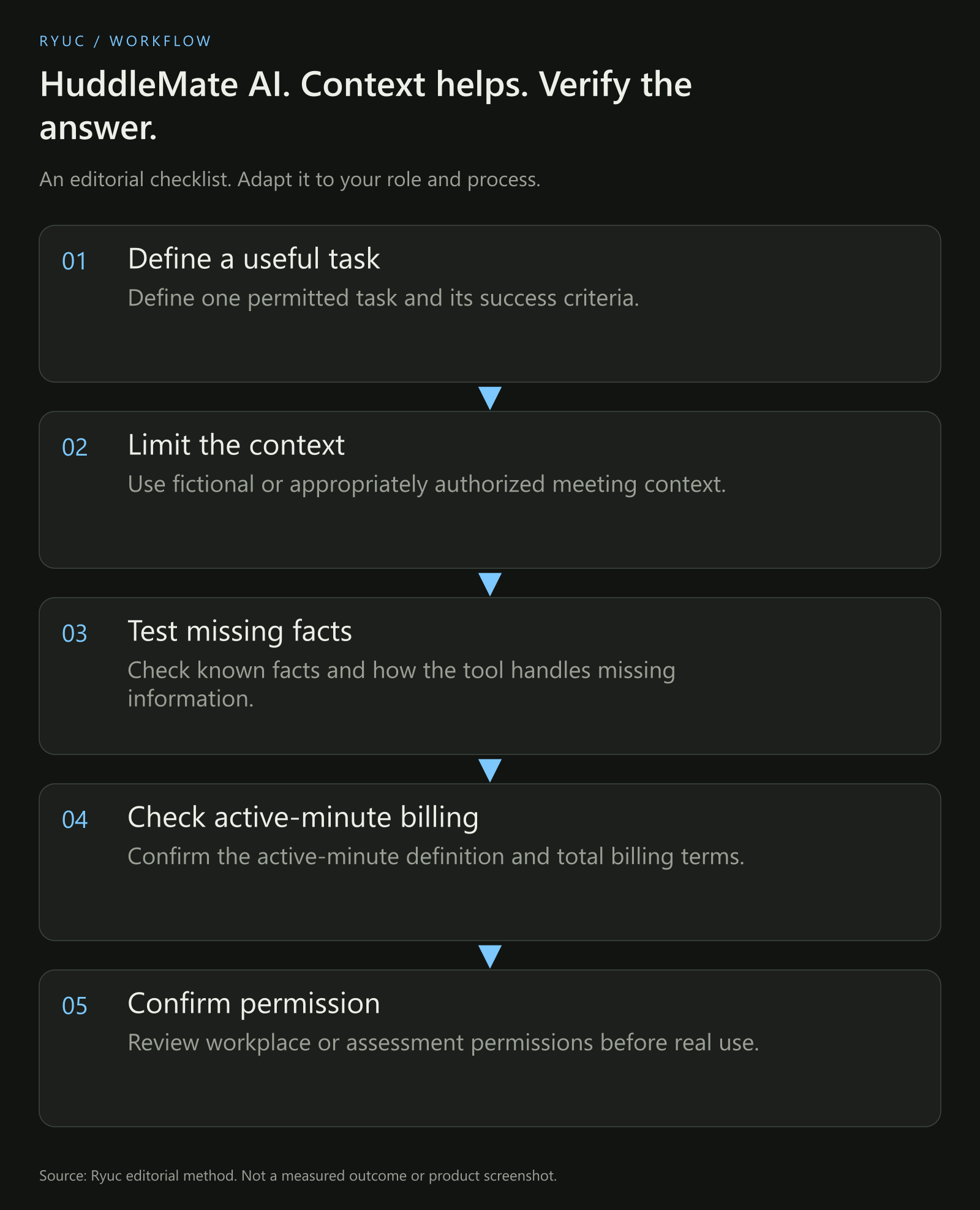
Our suggested evaluation design. It is not a product performance result.
Record correctness, missing context, distracting suggestions and the effort needed to verify them. Include a follow-up that changes a constraint so you can see whether the response adapts appropriately.
After the session, review the output against the original brief. If the tool invents a commitment, the relevant issue is factual reliability, even if its tone sounds confident.
What changes when the use is an interview?
Check the rules before using assistance. If the employer permits an AI-assisted exercise, demonstrate that you understand and can improve suggestions. If the assessment is restricted, use the tool for preparation instead.
For a candidate, an answer in STAR format still needs to describe a real experience. Our behavioral interview guide shows how to organize facts without inventing achievements.
For an employer, the useful response is clear assistance rules and job-related evidence. Read the interview-integrity guide rather than relying on a universal detection promise.
Your next steps
- Define one permitted task and its success criteria.
- Use fictional or appropriately authorized meeting context.
- Check known facts and how the tool handles missing information.
- Confirm the active-minute definition and total billing terms.
- Review workplace or assessment permissions before real use.
Download the HuddleMate trial checklist.
Frequently asked questions
Does HuddleMate only work for interviews?
Its public site presents broader meeting and conversation use. Evaluate the exact mode and workflow you need rather than assuming all situations have the same requirements or rules.
Is a suggested answer automatically accurate?
No. Context-aware output can still omit information or invent a detail. Verify facts and commitments against authoritative material before relying on a suggestion.
Did we verify its invisibility claims?
No. We reviewed the public description, not a hands-on test. Visibility claims do not determine whether recording, processing or assessment assistance is permitted.