Cluely's current public positioning centers on meetings: context-aware suggestions during a call and notes afterward. That is broader than the interview-cheating discussion often associated with real-time assistants.
Short answer: Evaluate Cluely against a permitted meeting task and a clear data policy. Its claims about hidden operation do not establish consent, confidentiality, factual accuracy or permission in an assessment.
What we verified: We reviewed the official public site on 27 October 2026. We did not install the application, test invisibility or validate its transcription and response-time metrics.
What does Cluely currently describe?
The reviewed page presents conversation context, on-demand suggestions and meeting notes. It says the application does not join as a meeting bot and markets concealment from screen sharing. Those are vendor descriptions, not our independently measured results. Source: Cluely.
A useful buying question is what problem the tool solves in your actual meeting. Retrieving a fact from approved notes, summarizing a decision and proposing an answer are different tasks with different error costs.
How is live assistance different from a notetaker?
A notetaker mainly helps reconstruct what happened. Live suggestions may influence what you say next. That makes verification especially important when the output includes a commitment, a price, a technical claim or a statement about someone else.
The same product can offer both functions, but they should be evaluated separately. A readable summary does not prove that a real-time recommendation is accurate.
Our HuddleMate guide describes a similar distinction around context-aware suggestions, while the Natively guide examines local-storage and provider questions.
What should a meeting trial contain?
Use a fictional brief with known facts, a proposed decision and an unresolved issue. Run a permitted practice conversation and inspect whether the notes preserve those differences.
Ask one question whose answer is present and one whose answer is missing. A reliable review should notice unsupported additions rather than reward confident language.
For example, “We might launch next month if testing passes” should not become “The team committed to launching next month.” The difference matters even when the summary looks polished.
What does a careful evaluation process look like?
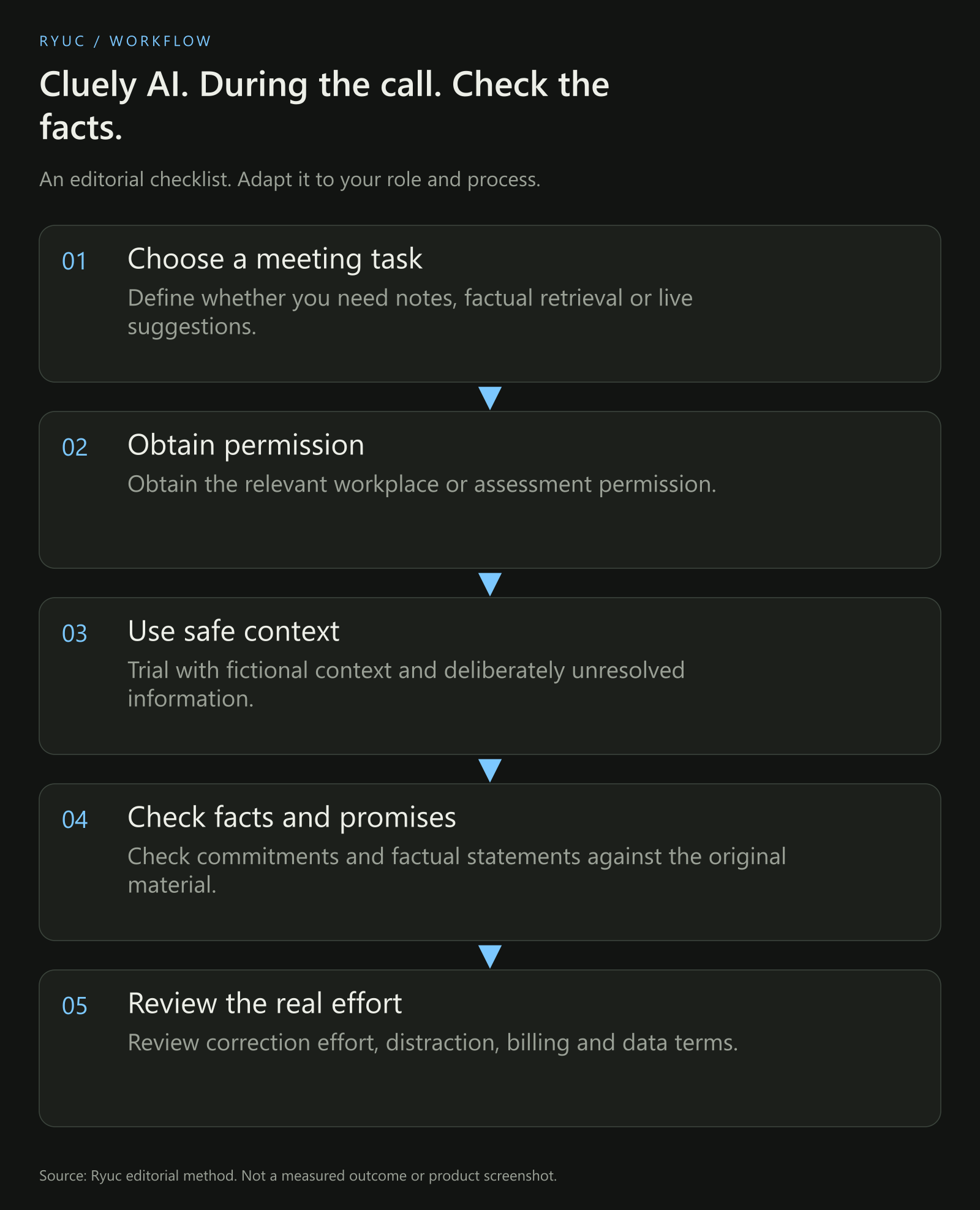
Our suggested evaluation method. This figure is not a product screenshot or a benchmark.
Record the effort required to check and correct output. An assistant that produces many suggestions may create more work if each one needs extensive verification.
Evaluate distractions too. If attending to the tool causes you to miss a colleague's clarification, the useful result may be worse despite impressive output in a demo.
Does no meeting bot mean no permission is needed?
No. The way a tool appears in a call is separate from whether you are allowed to capture, process or share the conversation. Check organizational rules and the relevant participants' requirements before using it with real work.
Use minimal information when evaluating a service. A screen can reveal unrelated messages or confidential documents. A meeting summary can also contain information that should not be distributed broadly.
This article is not a security audit or a legal opinion about a particular deployment. Review the current terms and the rules applicable to the intended use.
How should you interpret its performance numbers?
The public page reports numerical transcription and response metrics, but the page alone does not give us an independent evaluation for your language, audio conditions or meeting type. We therefore do not treat those figures as a guarantee. Source: official page.
If a metric matters, ask what it measures, which inputs were used and how errors were counted. Test an authorized representative sample before making an operational decision.
What changes for interviews?
An interview has its own assessment rules. Use preparation assistance or an explicitly permitted format; do not infer permission from the product's visibility claims.
Recruiters should define the assessment conditions and check job-related reasoning. A tool's existence does not justify assuming that every pause or polished answer signals misconduct. The Parakeet integrity guide provides a more proportionate process.
Candidates can use a practice conversation to improve clarity, then explain the same material unaided. Our behavioral answer guide focuses on truthful examples and ownership.
Your next steps
- Define whether you need notes, factual retrieval or live suggestions.
- Obtain the relevant workplace or assessment permission.
- Trial with fictional context and deliberately unresolved information.
- Check commitments and factual statements against the original material.
- Review correction effort, distraction, billing and data terms.
Download the Cluely evaluation checklist.
Frequently asked questions
Is Cluely only an interview tool?
The reviewed public page emphasizes meeting assistance and notes. Evaluate its current offering rather than assuming it has only one use case based on older discussions or another product category.
Does a hidden interface establish privacy?
No. Interface visibility and data handling are separate issues. Check what information is captured, processed, retained and shared in the configuration you intend to use.
Did we test its transcription accuracy?
No. This article analyzes the current public description and proposes an evaluation method. It does not establish a measured accuracy result or a universal reliability claim.